
























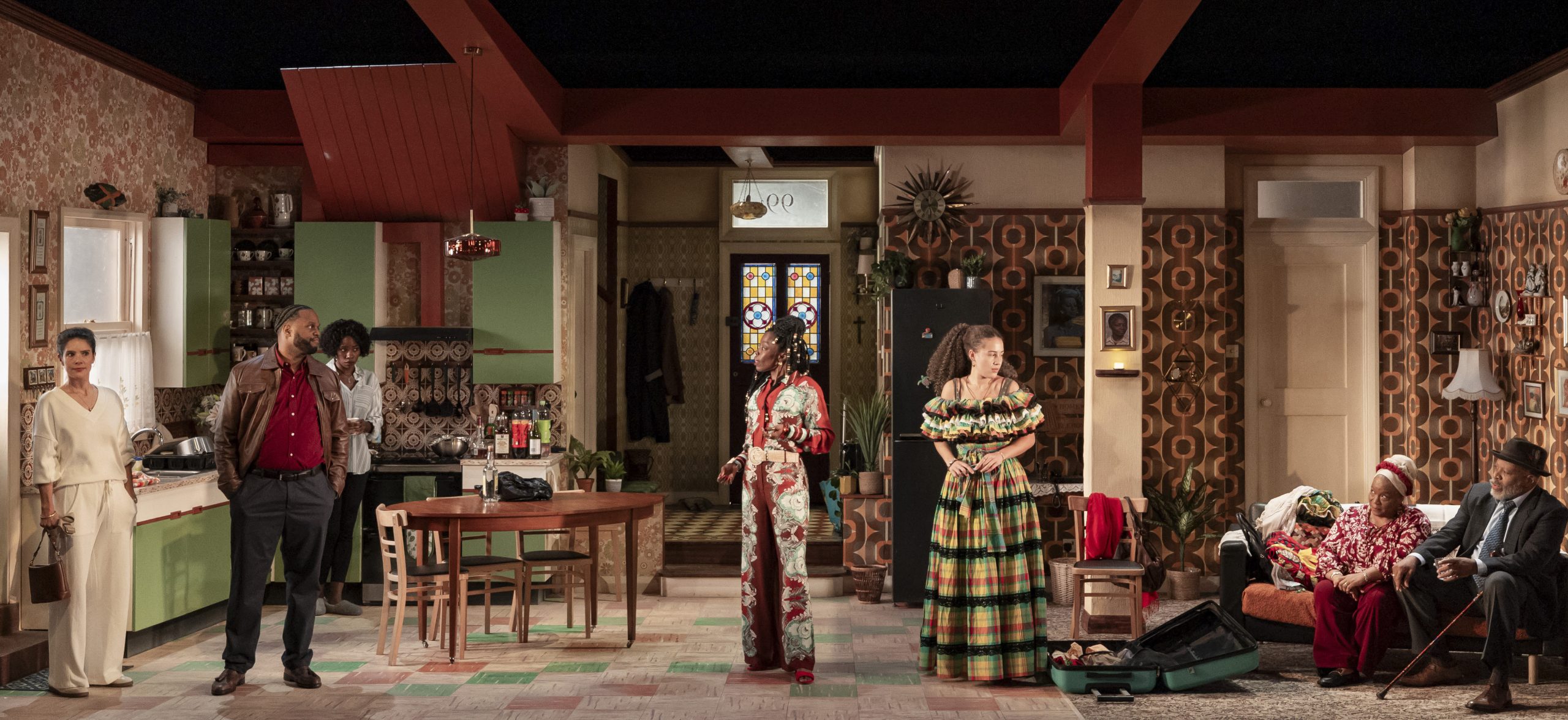
Eight years ago, Nine Night debuted at the National Theatre, where it was met with praise and thrust its writer, Natasha Gordon, into the limelight, earning her the Charles Wintour Award for Most Promising Playwright at the Evening Standard Theatre Awards as well as the Critics’ Circle Award. Its West End transfer that same year made Gordon the first Black British female playwright produced in the West End.
But for many who watched that initial run, it was probably a first glimpse of something they’d never encountered before: the Jamaican tradition of Nine Night, when family and friends mourn, share memories and celebrate a life.
A Nine Night is an act of love, and Gordon’s play deftly paints a hypnotic and compelling picture of it. Her approach to explaining the tradition itself is unapologetic: for an audience unfamiliar with the rituals and minutiae, the cultural importance may take time to fully register. Gordon isn’t attempting to coddle audiences; rather, she makes space for blooming storytelling in the finer details, enhanced by Libby Watson’s beautifully crafted set and distinct costumes, which provide the context for characters, place, time and past history.
The play opens with the family gathered at the home of the unseen matriarch, Gloria, bedridden with illness, in the hope she’ll pull through. Her children, Lorraine (Dani Moseley) and Robert (Javone Prince), keep vigil alongside Lorraine’s daughter, Anita (Ava Hinds-Jones), Robert’s partner, Sophie (Sonya Cassidy), and Aunt Maggie (Llewella Gideon) and Uncle Vincent (Gary McDonald). The mood soon shifts from hope to grief when Gloria passes away, sparking the Nine Night in question.
As the family reflect on Gloria’s impact on their lives, they inevitably clash or contrast across generational, cultural or social lines.
Robert’s work in finance (his gilet and polo shirts are deft touches) and capitalist outlook sit at odds with Anita’s youthful yet tokenistic activism, while Lorraine’s achievements as both a mother and daughter are needled by her Aunt Maggie, Llewella Gideon, in career-best, national-treasure mode. Meanwhile, Robert’s white partner, Sophie, may seem like an outsider, but her place in the family and love for it are rendered honestly: her devotion to Gloria and the support she gave her seeps out gradually.
A conversation between Robert and Uncle Vincent sketches out the Black British experience, speaking to modern stories of immigrant families flourishing in spite of all the odds and expectations.
The play bristles with energy whenever Aunt Maggie is on stage; her lines are highlights. “We don’t cook our people!!!” drew laughs that could fill a football stadium. Likewise, the song selection from music consultant Eddie Lockhart got my head bopping often, and soundtracks a beautiful moment where Uncle Vincent dances alone.
This revival, directed by Amit Sharma, arrives at a time when it has something even more potent to say. Black British identity is continuously being dragged into conversation and dog-whistle discourse, in corners we’ve long avoided being backed into. Whether it’s Aunt Maggie’s boasts about her daughter’s achievements, the prospect of having children in an interracial relationship, absent fathers, class, societal perception, the burden of family, upholding cultural traditions in adopted lands, or the contrast between ritual as a routine or something more deeply connected to roots, respect and responsibility to legacy, Gordon’s opinions on all the above aren’t sugar-coated or served to appease.
While the play suffers from sag and stasis in its final third, largely due to a lack of development of some character and story arcs, its climax is a beautifully rendered sequence that not only marks the introduction of Lorraine and Robert’s sister, Trudy (Estella Daniels), but also injects much-welcome magical realism and soft-supernatural horror.
If this is Gordon’s opus, a deeply personal and conscious piece, it is an exercise in holding up a mirror to the many contrasts that both connect and distinguish us. It is a picture of joy that reminds us that everything we do matters, and that it will live on long after we’ve gone: in our memories, and in the people who carry them forward.
NEED TO KNOW: Nine Night plays at the Kiln Theatre until 9 Jan 2027
RELATED LINKS