





















It’s Hamlet, but not as we know it. On paper, fusing Shakespeare’s Prince of Denmark with Radiohead’s acclaimed 2003 album Hail to the Thief sounds borderline bonkers. Yet somehow, it doesn’t just work, it thrills. Now playing at the Barbican Theatre, Hamlet Hail to the Thief won’t necessarily satisfy purists of either the Bard or the band. Instead, this collision between one of English literature’s greatest tragedies and one of the 21st century’s most politically charged albums, delivers a dark, electric and compelling theatrical experience unlike anything I’ve seen before.
Condensed into a breathless 100 minutes, this is Hamlet with the fat trimmed off. Still unmistakably Shakespeare, but stripped back into something altogether tighter, darker and more urgent. Set in a shadowy and unsettling version of Elsinore, the production drops us straight into the aftermath of the King’s death. His brother Claudius (Paul Hilton) has wasted little time claiming the throne and marrying his dead brother’s widow, Gertrude (Claudia Harrison). However, the ghost of Hamlet’s murdered father reveals that Claudius is his killer. Consumed by grief, anger and need for revenge, Hamlet (Samuel Blenkin) becomes increasingly erratic, as the corruption and dishonesty surrounding him begin to unravel.
By cutting back other parts of the play, the production places greater emphasis on the relationship between Hamlet and Ophelia (Ami Tredrea), giving her eventual decline and death more emotional impact. In a particularly striking moment, Hamlet delivers his famous “To be, or not to be” soliloquy directly to her, only for Ophelia to hauntingly echo the words shortly before her own demise. Hearing Ophelia repeat those same words later gives the speech a heartbreaking tone, as though Hamlet’s despair has somehow become her own.
Samuel Blenkin leads the cast with an edgy, unsentimental portrayal of Hamlet. He is compelling to watch, conveying the prince’s volatility as he swings between vulnerability, anger and apparent madness. Ami Tredrea matches his intensity, bringing Ophelia a sharper intelligence and emotional depth than we often see in more traditional productions.
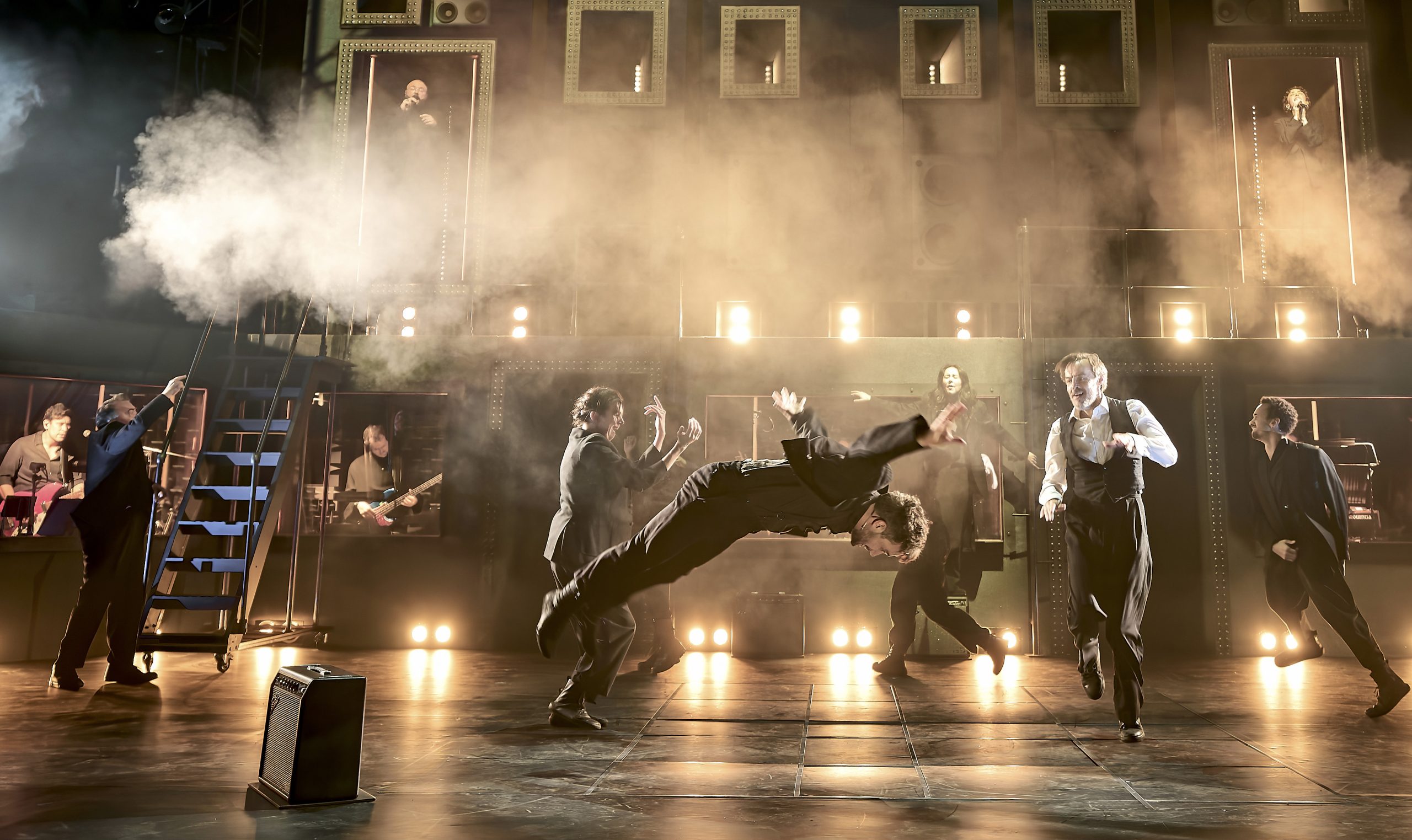
Paul Hilton is effortlessly smooth yet chilling as Claudius, while Claudia Harrison gives a thoughtful performance as Gertrude, caught between loyalty to her new husband and concern for her son. Watching over the action from glass-fronted booths on the stage, a live band delivers the reworked Radiohead score, driving the production forward with a relentless, hypnotic energy.
The adaptation by Christine Jones and Steven Hoggett, with orchestrations by Radiohead’s Thom Yorke, is an intriguing marriage of Shakespeare’s original text and the band’s lyrics, with the two sitting together more naturally than I expected. The decision to strip back the play rather than attempt to squeeze in every familiar speech gives the production a welcome sense of pace, while retaining enough of Shakespeare’s language to preserve its emotional and poetic power.
Meanwhile the songs complement the themes of betrayal, political corruption and disillusionment, often feeling like a natural extension of the dialogue rather than simply being dropped into the action. Yorke’s reworkings provide a suitably unsettling soundscape, reinforcing the sense of paranoia and impending disaster that runs through the story.
Hoggett and Jones also serve as co-directors and make movement central to their storytelling, using the physicality of the actors to convey the mounting tension, anxiety and oppressive atmosphere of Elsinore. Rather than relying solely on traditional interpretations of Shakespeare’s verse, they weave together spoken dialogue, movement, music and choreography to create a production that feels as much like a piece of physical theatre as a conventional Shakespearean drama. The result is an energetic, fast-moving and frequently striking piece of theatre, where the choreography becomes another language through which the characters’ inner turmoil and the growing sense of unease are expressed.
Hamlet Hail to the Thief is a bold and imaginative piece of theatre. The combination of Shakespeare and Radiohead might seem unlikely, but there is a genuine connection between the two, particularly in their shared exploration of political corruption, alienation and the darker aspects of human nature. It may not satisfy Shakespeare purists or Radiohead fans hoping for a straightforward performance of the album, but its accessibility could introduce new audiences to both, while others may find themselves pleasantly surprised by what they discover.
Visually striking and packed with moments of real theatrical power, Hamlet Hail to the Thief is an unconventional and compelling way to revisit the familiar tragedy. It demonstrates that Shakespeare’s themes, like Radiohead’s music, can continue to connect with audiences long after their creation.