


















Caryl Churchill’s Cloud 9 is part comedy, part social satire and part exploration of sexual identity, colonialism and patriarchy. It challenges conventional attitudes towards gender, sexuality, race and power, themes that remain just as relevant today as they were when the play was first performed in 1979. Its unconventional structure challenges the audience to abandon usual expectations of how a play should unfold, making for a theatrical experience that is anything but predictable.
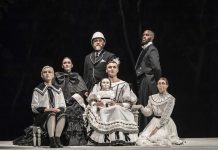
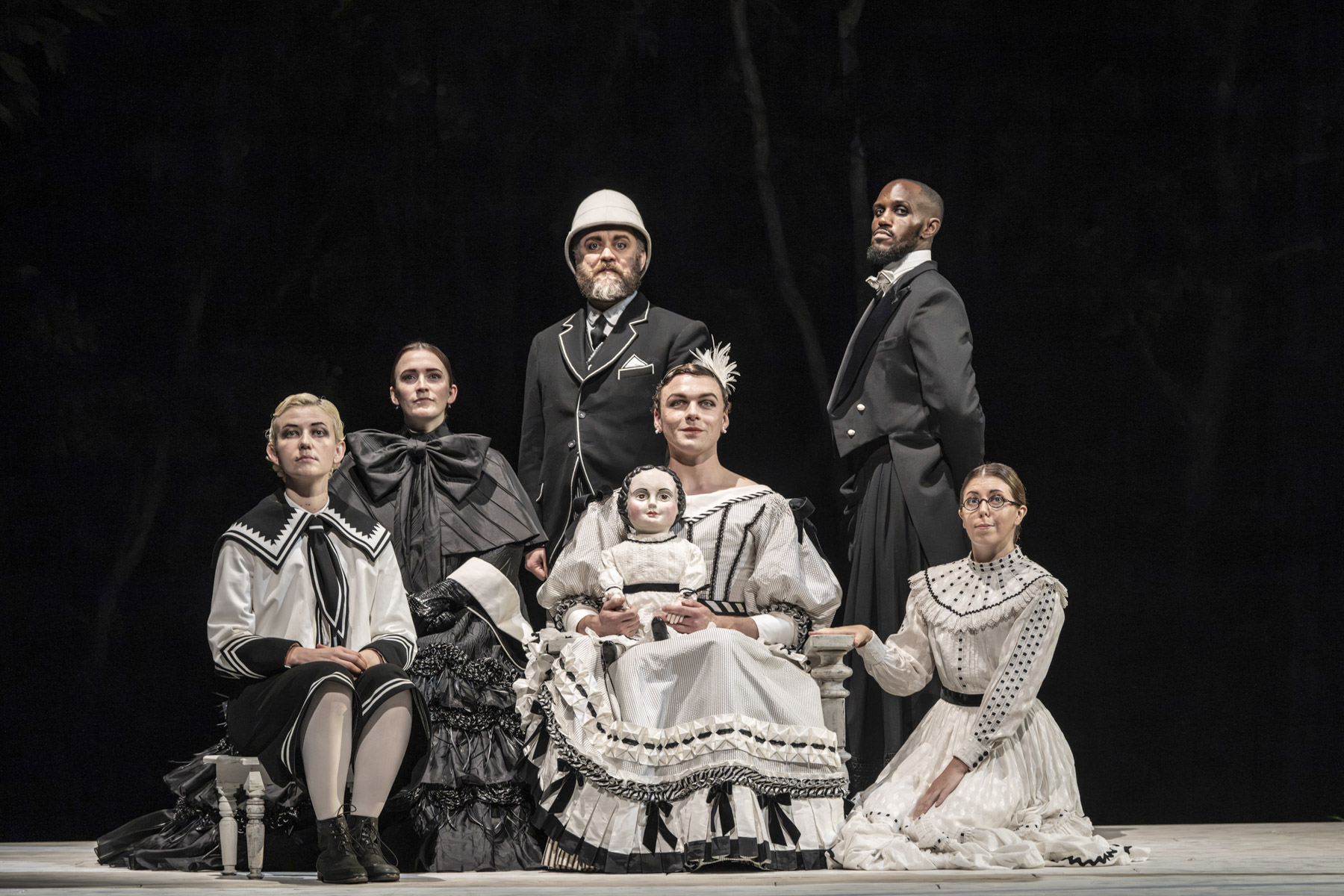
The story plays out over two different acts, separated by approximately a century in historical time but only 25 years in the lives of its characters. The first is set in Victorian colonial Africa, where Clive (Sam Troughton), a British colonial administrator, presides over a household comprising his wife, children, a servant and various friends. Beneath the outward appearance of Victorian respectability, forbidden desires and suppressed sexuality simmer away.
Clive’s wife Betty (Stuart Thompson) is expected to be the model Victorian woman, devoted to her husband and family. However, she secretly harbours romantic feelings for family friend Harry Bagley (Tom Mothersdale), unaware that his interests lie elsewhere. Harry is a closeted gay man whose sexual advances towards the much younger Edward (Ellen Robertson), Clive and Betty’s son. Edward, meanwhile, resists conforming to the traditional masculine role expected of him, preferring to play with his sister’s doll than participating in sporting activities.
The household also includes Joshua (Eloka Ivo), the family’s African servant, who outwardly appears to accept his subordinate position but occasionally finds ways to resist the colonial authority imposed upon him. Ellen (Rebecca Humphries), the governess, and Mrs Saunders (Humphries, again), a widowed family friend, also harbour secret sexual desires. Completing the household is Clive’s mother-in-law, Maud (Charlotte Ritchie), who acts as a guardian of Victorian morality and respectability.
The second act transports us to London in 1979. Although over a hundred years have passed, the characters have aged by only 25 years. The world around them has changed considerably and there is a greater willingness to explore different forms of identity and sexual expression. Betty has left her marriage and is attempting to discover who she is outside the role of wife and mother. Edward, now an adult, is openly exploring his sexuality and is in a relationship with promiscuous Gerry (also played by Eloka Ivo), and seemingly in a throuple with two women, one of which is his sister Victoria (Charlotte Ritchie). Their greater sexual freedom does not bring greater emotional fulfilment and the characters continue to grapple with relationships, commitment and the difficulty of understanding what they really want from life.
Director Dominic Cooke does a good job of balancing the play’s outrageous humour with its more serious observations. He has assembled a strong cast for this revival, with the multiple roles demanding considerable versatility. Sam Troughton displays an impressive range, moving between the authority of Clive and the very different character of Cathy, an infant child. Stuart Thompson and Ellen Robertson share the roles of Betty and Edward between the two acts, while the remaining cast members also take on several characters. The company handles these changes with considerable dexterity, moving effortlessly from the stiff, exaggerated mannerisms of the Victorian characters to the more searching and emotionally complicated individuals of the second act.
For all its strengths, however, the play does occasionally feel dated, and some of its material sits less comfortably with a contemporary audience. The treatment of Harry’s sexual interest in the young Edward, for example, is particularly uncomfortable, as is the association between homosexuality and paedophilia which risks reinforcing an unfortunate stereotype. Meanwhile, the free love and sexual experimentation of the second act sometimes feel overdone, as though the characters are more concerned with challenging conventions than developing convincing relationships. The production also makes for a long evening, running approximately 2 hours and 45 minutes, although this includes an extended interval during which the entire audience is asked to leave the auditorium so they could reset the stage.
Cloud 9 is funny, provocative and occasionally bewildering and asks its audience keep up with its shifts in time, place and character. Beneath the playful humour lies a more serious examination of how power operates in our private lives as well as in wider society. Some of its ideas feel more dated today than they might have when the play was first written, but its central questions about identity, freedom and equality remain important. This National Theatre revival provides an opportunity to revisit an important work of British theatre and reflect on how much, or perhaps how little, society has really changed.
NEED TO KNOW: Cloud 9 plays at National Theatre until 13 Jan 2027.