




















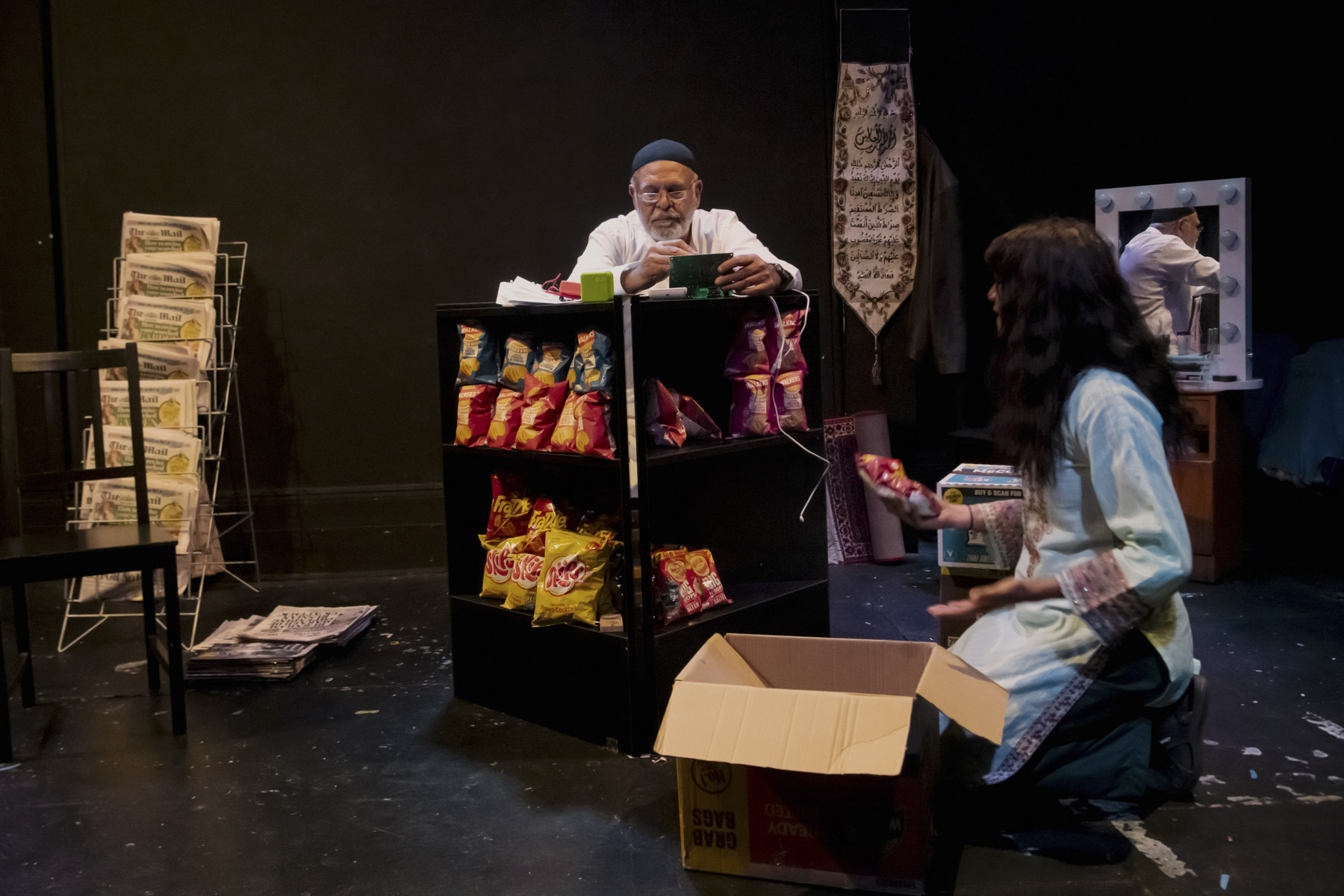
The Bridge House Theatre is a pub venue that I have never frequented, even though its southeast London location is not far from home. This intimate, rustic, black-box theatre is staged in a thrust, with modest seating. The space was set as a corner shop adorned with a decorative Urdu wall hanging, a Walkers crisp-filled counter, a dated Wall’s ice cream sign, a newspaper rack displaying the Daily Mail – the shop’s only rag, and CCTV images projected from the interior of the shop.
Bursting into the space, (underscored by the pulse of dancehall and house music) enters the high and agitated Terri, a Basildon native, who is down on her luck, fresh out of hope and without a place to call home. She searches through her only possessions – a worn sleeping bag, a stained coat, beer cans, remains of a takeaway and used tissues.
Terri is waiting for her unlikely friend Malik; the elderly proprietor of the convenience shop she is sleeping outside of. Malik, a migrant from Karachi, immigrated to the UK in the 1970s to pursue his dream of being an electronics inventor. Much like Terri, Malik is left out in the cold – his ethnicity being a barrier to his upward mobility – in racist England. For the stability of his wife and their young child, Malik forsakes his dream and becomes a debt-laden shopkeeper instead.
Terri’s back story is a mystery, her addiction forces her to bounce from shelter to shelter. She speaks of her nan fondly – the inspiration behind her becoming a baker. Terri’s love for cooking is a link to her past life, a memory she hangs onto dearly.
Malik tends to Terri’s hunger, thirst and warmth, while Terri helps out, doing odd jobs around the shop. Both keeping each other company through light-hearted banter and memories of kinder times. This understandable distraction tactic serves to push away the constant anxiety of living in a crisis-filled 2026.
Nida Vohra has written a pithy, heartwarming play, which brings into sharp focus the humanity which bonds us together. The protagonists in her work are from totally different backgrounds, ethnic communities and generations; but they both have a mutual respect and care for each other.
Vohra directs the transitions and movement sequences very well – navigating the tight space in creative ways, especially when the characters break the fourth wall and interact with the audience. However, the pacing of some scenes can sometimes be too lengthy, causing a loss of energy and impact, which does a slight disservice to the writing.
Emma Stannard (Terri) and Sanjay Batra (Malik) are well cast; from the outset they deliver authentic, character-driven and charismatic performances – which forces you to care about their past stories, providing empathy for their present predicaments and makes one wonder what the future will hold for them.
Tragic circumstances push Malik and Terri to confront their stark realities, forcing them to make life changing decisions.
High Street is a short play leaving you wanting to see and hear more from the characters. I believe the play could benefit from a deeper exploration of the characters and their worlds. I would love to see a longer adaptation and even a short film. High Street has several important messages woven throughout, messages of resilience in adversity, of being your brother’s keeper while inspiring others, and that we have more in common with each other than we perhaps think. In this divisive society that we find ourselves negotiating, we should hold these messages dear to our hearts.
NEED TO KNOW: High Street played at the Bridge House Theatre from 17-19 Sep 2026






![Kathy Kiera Clarke, Denis O'Hare in Tartuffe by Molière in a new version by John Donnelly. [Image by Manuel Harlan]](https://www.afridiziak.com/wp-content/uploads/2019/09/Kathy-Kiera-Clarke-Denis-OHare-in-Tartuffe-by-Molière-in-a-new-version-by-John-Donnelly.-Image-by-Manuel-Harlan-324x160.jpeg "Tartuffe")