





















Pretty, bloody, perfect.
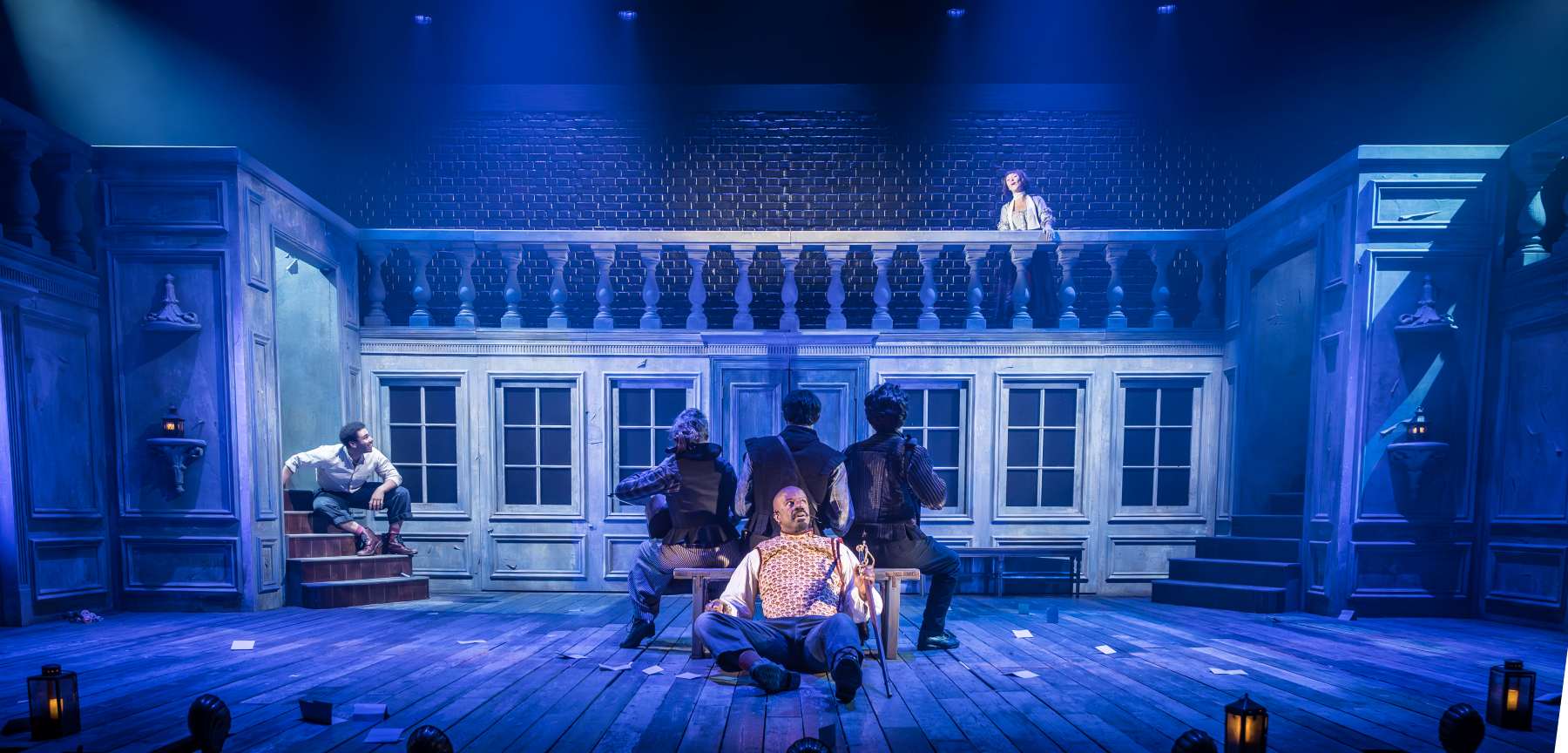
Few stories have travelled like Edmond Rostand‘s eponymous hero. Its central conceit has been so woven into popular culture its origins are often forgotten: a man, ashamed of his appearance, hidden beneath a canopy of climbers, proclaiming his love through a surrogate to a woman standing high above him on a balcony. As cultural shorthand for yearning, Cyrano is the original Loverboy.
His myth has birthed many reinterpretations that we encounter its descendants (for me, Steve Martin‘s Roxanne) long before we meet the man himself. Years after studying the play, I finally made his acquaintance at the Noël Coward Theatre in Simon Evans‘ brilliant new production, co-adapted with grime poet Debris Stevenson. I am glad to have met the man, the myth, the legend that is Cyrano de Bergerac.
As someone who loves words, I spent much of the first half smiling from ear to ear. This is absolute catnip for literary babes. Stevenson writes less as an epic poet than a hip-hopera; Roxane and Cyrano battle rap, each determined to land the final word. But for a play so deeply concerned with words, it was striking that the words which stayed with me were not uttered on stage at all, but Stevenson’s writing philosophy that serves as the production’s central claim: “The body is the music is the word.”
Cyrano de Bergerac traces the consequences of a lie. Outwardly, Cyrano determines to give Roxane what she claims to want: the handsome Christian, played with warmth, humour and surprising emotional range by Levi Brown. In doing so, he becomes the conductor of his own demise. Every decision that flows from it, every lie that tumbles towards its inevitable conclusion, brings about his own tragedy.
By giving Christian the power of his voice – his extraordinary gift for words – he orchestrates his own obsolescence while providing both Christian and Roxane with versions of one another that do not exist.
Adrian Lester is astonishing. He stretches and flexes his entire self into the crevices of this character until Cyrano seems to exist not simply in his performance but in the edges of his body. Where Rostand’s famous prosthetic could easily become comic, on Lester it is rendered entirely un-ridiculous. Like Roxane, we stop seeing it because we fall for the words.
In Rostand’s original, Roxane belongs to the tradition of the précieuses: the brilliant, witty women of the seventeenth-century French salons. Stevenson and Evans do not modernise those qualities so much as give them contemporary feminist grounding, brought to life by a dazzling Susannah Fielding, whose Roxane meets Lester bar for bar with physical and intellectual agility. When she finally discovers the deception, this production allows her to claim the righteous anger that Rostand denied her, naming the manipulation for what it is: controlling and humiliating. But neither is she a guileless victim.
Cyrano’s insistence that she must have known it was him points to the absurdity of the conceit itself: that this brilliant woman would fail to recognise the mind she has sparred with for decades. This exchange is what earns the story its contemporary resonance, in its gender politics and in how easily modern life lets us hide who we are, behind avatars and screen names.
As Cyrano lies dying, Roxane, who had once dismissed the word “love” as too small, too sharp, now begs to hear it. He cannot say it. Not because the audience needs one final tragic flourish, but because these writers know that failing at this is the most truthful thing about him. His lie is not a sacrifice but a theft: a theft of reality, of peace of mind, of possibility. It condemns Roxane to spend fifteen years writing love letters to a ghost instead of the man she already loved, however unknowingly. Again and again, Cyrano approaches the edge of the truth only to retreat from it.
At this moment, a recurring image of a child with Cyrano’s nose appears, one of the production’s most inspired additions. To me, he reads less as death itself than as the wound Cyrano has carried since childhood. Appearing whenever death or profound trauma draws close – on the battlefield, after Christian’s death and finally at Cyrano’s own bedside – he externalises the frightened child Cyrano has spent a lifetime protecting.
The lie steals more from that child than anyone else, despite being formed to protect the part of himself that cannot believe the face it inhabits could ever be worthy of love.
What gives the ending its emotional force is that Roxane knew the boy, so when she sees him as the great man dies, she finally understands both. The disguises have fallen away, and the words finally fail him. What remains is the face he has spent a lifetime hiding and, in the production’s cruellest and kindest irony, it is that face, rather than the protection and performance of words, that finally brings him peace.
Stevenson‘s deceptively simple line from the programme becomes clear: “The body is the music is the word.” Throughout, words are never separate from the lives they create. They form bodies, bend promises, complicate truth and keep us honest. Cyrano’s lie was finite. The word, however, proved itself otherwise. In the hands of Evans, Stevenson, Lester and this extraordinary company, it continues to travel.
NEED TO KNOW: Cyrano de Bergerac plays at the Noël Coward Theatre until 5 Sep 2026