


















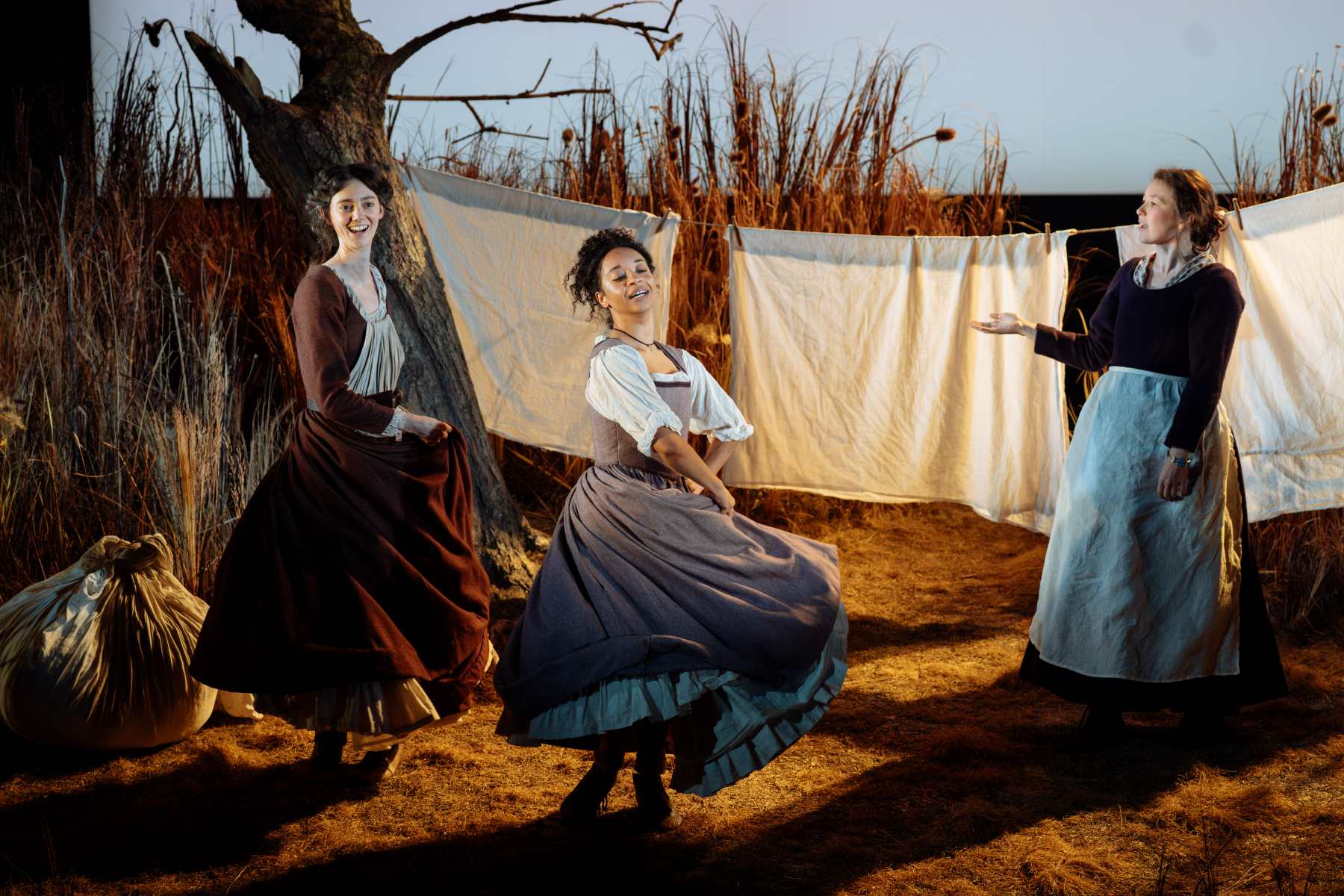
Playwright Ava Pickett’s 1536 takes its title from the year Anne Boleyn was executed on the orders of King Henry VIII. While her downfall casts a long shadow over the drama, Anne herself never appears, and the action unfolds far from the intrigue of the royal court. Instead, Pickett brings history down to earth, quite literally, setting her play in an Essex field where three young women gossip, tease and speculate about the upheavals shaping their lives.
The result is a compelling and intelligent play that feels both steeped in Tudor history and very contemporary in its exploration of misogyny, power and the constraints placed on women, drawing striking parallels with modern debates around gender and control.
From its provocative opening, Anna (Siena Kelly) having sex against a tree with Richard (Oliver Johnstone), who is later revealed to be engaged to Jane (Liv Hill), 1536 makes it immediately clear that this is no genteel, sanitised portrait of Tudor England. Pickett strips away any romanticised notions of the period to expose a brutally patriarchal society in which men wield power with impunity, while women are judged, controlled and treated as property.
A king could have affairs without consequence, yet it was his wife who would face condemnation and public humiliation. That hypocrisy seeps through every level of society, an attitude that infects the play’s world like a toxic Tudor version of the manosphere.
The play unfolds through the conversations between Anna, Jane and their friend Mariella (Tanya Reynolds), a local midwife. Anna is rebellious and strikingly aware of her beauty, using it to attract men, and she is not short of admirers. Jane, by contrast, is more conformist, determined to be the “good girl” she believes men desire. Mariella is the group’s more perceptive presence; her dry wit concealing the hurt of having been discarded by William (George Kemp), who abandoned her to marry for status and security. Their exchanges are playful and unapologetically bawdy; nothing is off limits, and the swearing is colourful enough to make characters in a Quentin Tarantino film blush.
What begins as casual gossip soon darkens as the turmoil of the royal court reverberates through wider society and into these women’s lives, exposing tensions around class, desire and survival. Anna’s sexual independence is met with harsh judgment from the local community, Jane’s forthcoming marriage is revealed as a loveless social contract, and Mariella’s stoic pragmatism is shown to be a defence against her own heartbreak.
With direction by Lyndsey Turner, the production relies heavily on the chemistry between its three leads and they deliver magnificently. As the beautiful and defiant Anna, Siena Kelly is electric, portraying a woman who understands that her only real power lies in her sexuality, a currency that rapidly loses value as the men around her turn hostile. Her descent from flirtatious confidence to raw desperation is heartbreaking. Liv Hill is also impressive as the naive Jane, whose impending marriage to Richard becomes one of the play’s central tensions.
“Ava Pickett’s 1536 is a gripping and unsettling work of historical fiction that feels very contemporary in its themes and concerns. Yet it is far from unrelentingly bleak; its flashes of biting humour bring warmth and vitality while making its darker truths land all the harder”
She captures the tragic innocence of a woman trying to play by the rules of a game rigged against her. As Mariella, Tanya Reynolds offers a more grounded presence, her dry wit and apparent pragmatism concealing layers of disappointment and resilience. Together, the three actors create a dynamic that feels authentically affectionate, competitive and fraught.
Ava Pickett’s 1536 is a gripping and unsettling work of historical fiction that feels very contemporary in its themes and concerns. Yet it is far from unrelentingly bleak; its flashes of biting humour bring warmth and vitality while making its darker truths land all the harder. With sharp intelligence, the play shows how misogyny and entrenched power structures seep through every level of society, dictating both the choices available to many women and the consequences they face.
Above all, it is a reminder that history is shaped not only in palaces and corridors of power, but also in the quiet, precarious lives of ordinary people, which, then as now, are often formed by forces beyond their control. Rich, incisive and thought‑provoking, 1536 is a piece of theatre that resonates well beyond its Tudor setting.
NEED TO KNOW: 1536 plays at the Ambassadors Theatre until 1 Aug 2026