
























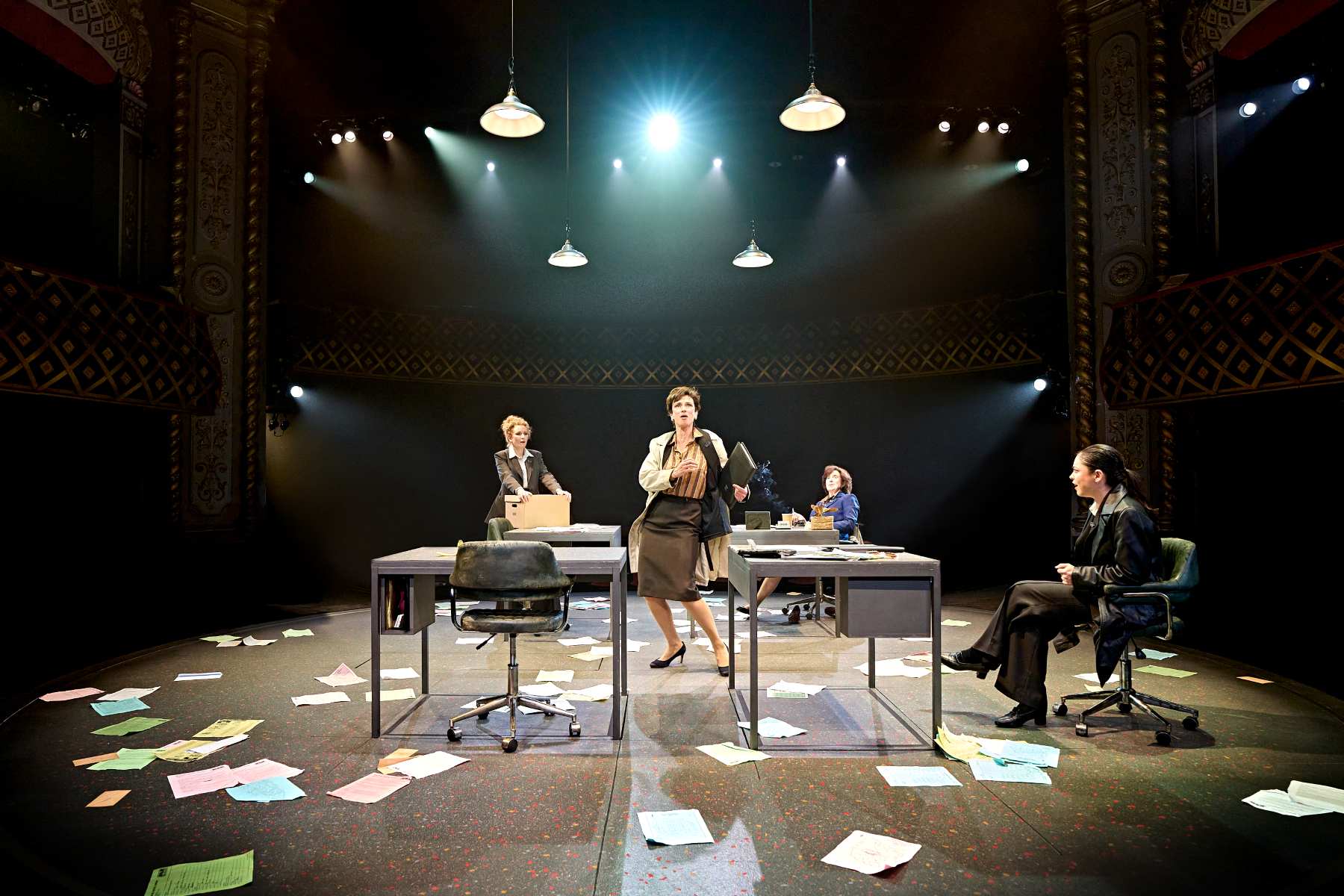
David Mamet’s Pulitzer Prize-winning play Glengarry Glen Ross was first staged in 1983 before being adapted into a celebrated Hollywood film in 1992. Now, more than four decades later, it returns to the stage in a new production at the Old Vic Theatre with one significant change. The play’s world of macho property salesmen, where ambition, ruthlessness and intimidation dominate, is now inhabited by an entirely female cast. Beyond the gender swap, almost everything remains unchanged, even the characters keep their original names, including the not very feminine-sounding Richard, John and James.
The play’s title combines two property developments, Glengarry Highlands, the latest scheme the sales team are struggling to sell, and Glen Ross Farms, a development they successfully sold in the past. Together, they symbolise both the elusive success the agents are chasing and the fading glory of better times. No character embodies this better than Shelly “The Machine” Levene (Indira Varma), once the firm’s star performer but now trapped in a devastating slump.
Desperate to revive fortunes, Levene resorts to pleading with, and eventually attempting to bribe, office manager John Williamson (Dorothea Myer-Bennett) for access to contact details of their most promising potential buyers. Elsewhere, the scheming Dave Moss (Niky Wardley) tries to recruit the hesitant George Aaronow (Nancy Crane) into a plan to steal the contact details, while the office’s top salesperson, Richard Roma (Rosa Salazar), uses charm, confidence and psychological manipulation to pressure the vulnerable James Lingk (Mercedes Bahleda) into buying some land.
At the centre of this production are two riveting lead performances. Indira Varma is superb as Shelly Levene, bringing a nervous, restless energy to a character whose confidence is slowly being eroded by failure. She captures both the swagger of a once-great salesperson and the mounting panic of someone desperately trying to avoid becoming irrelevant. Equally impressive is Rosa Salazar as Richard Roma, the office’s new star performer. Salazar gives Roma a slick and seductive charisma which she uses to terrifying effect to secure a sale.
The all-female cast do a remarkable job inhabiting roles originally written as embodiments of aggressive male competitiveness. Yet throughout the evening I was never entirely sure how the characters were meant to be understood. The production seemed to send conflicting signals. Levene’s swaggering, masculine physicality sits alongside moments such as Moss applying lipstick and Aaronow delicately sipping a cocktail through a straw. Rather than offering a coherent reinterpretation of Mamet‘s characters, these contrasting choices create an ambiguous middle ground in which I was left uncertain whether I was watching women in these roles or male characters simply portrayed by female actors. Had director Patrick Marber committed more decisively to either approach, the production’s intentions might have felt clearer regarding what the gender-swapped casting was ultimately designed to reveal about the play or its characters.
This ambiguity also affects the dialogue because Mamet’s script remains almost entirely untouched and certain lines land differently when spoken by female performers. Hearing Roma say “my balls feel like concrete”, for example, drew attention not to the character’s predicament but to the production’s gender uncertainty. The profanity-laden exchanges in Mamet’s script remain as ferocious as ever but they are so deeply rooted in the hyper-masculine culture of world the characters inhabit that they occasionally sit uneasily alongside the production’s female casting.
Ultimately, the production never fully convinces as a reinterpretation of Glengarry Glen Ross. A more transformative adaptation might have used its all-female cast to explore how power, ambition and moral compromise operate when viewed from a female perspective. Instead, Patrick Marber largely presents Mamet’s characters unchanged, asking his performers to inhabit a world still defined by the values and behaviours of the original all-male play.
Yet despite these reservations, the production succeeds thanks to the brilliance of Mamet’s writing and the exceptional quality of its cast. Indira Varma and Rosa Salazar deliver particularly compelling performances, while the ensemble as a whole tackles the demanding dialogue with energy and conviction. Glengarry Glen Ross remains a gripping study of greed, desperation and survival. This revival may not unlock many new dimensions within Mamet‘s play but it is compelling enough to remind us why it continues to be an intriguing and engrossing drama.
Glengarry Glen Ross plays at the Old Vic until 18 Jul 2026.