





















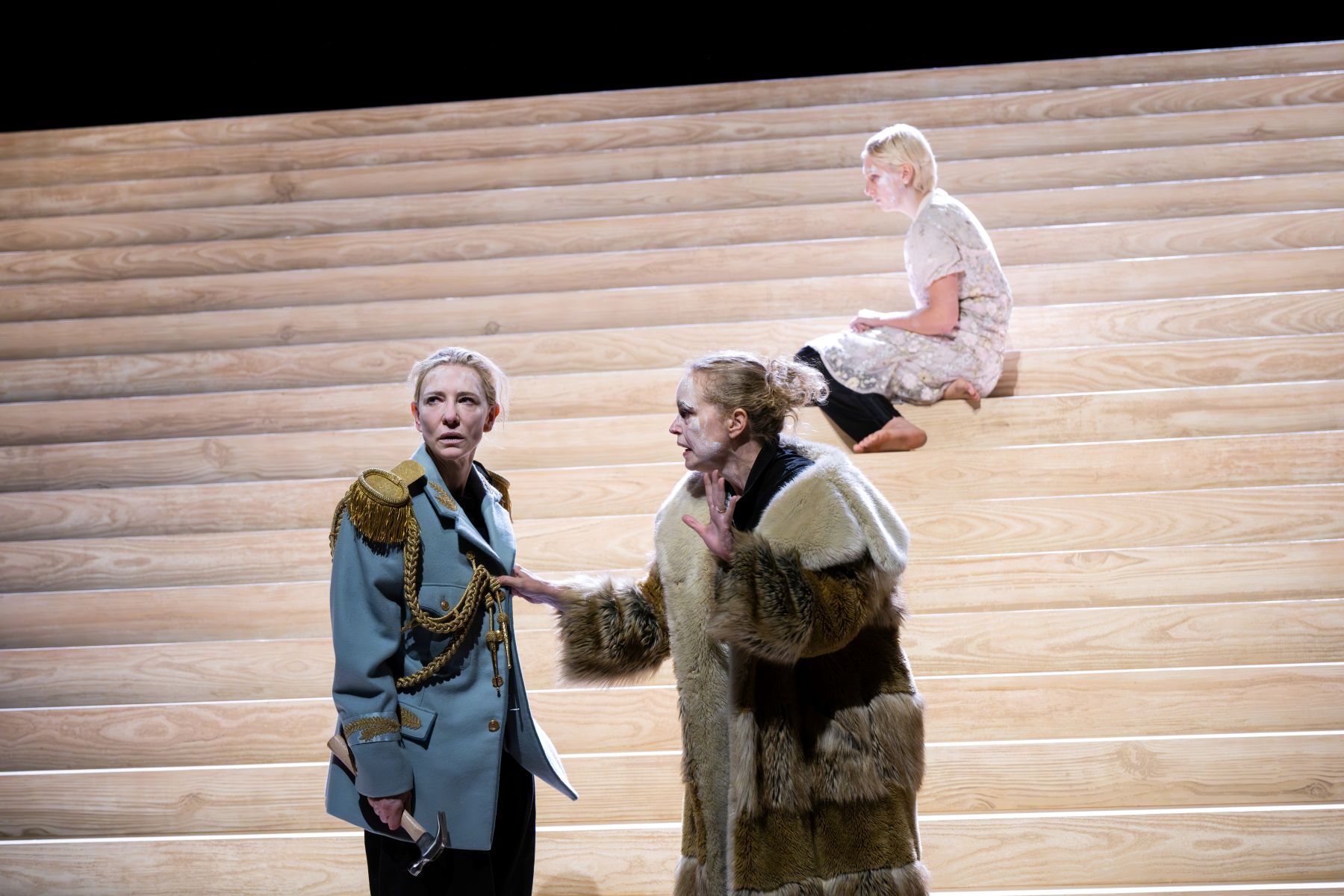
What can an actor do with absolutely nothing to hide behind? An empty staircase that occupies the whole of the Lyttleton stage at the National Theatre waits for us when we walk in. A brighter spot lights a hammer, like a Chekhovian gun, we know that’s the character that will lead the play. Peter Brook said, ‘I can take an empty space and call it a bare stage’. Here it doesn’t stay empty for long: it becomes a playground, then a trap, then whatever the actor standing in it needs it to be.
When two classic stories collide, one from film and the other from theatre, we should expect explosion. Electra by Sophocles and the movie Persona by Ingmar Bergman are the ingredients Benedict Andrews, writer and director, chose to bring this story to life. A modern amalgamation that takes us, mere theatre goers, right into the psyche of an actress, and witness the power the text can have over her. He dissolved the idea that an actress should only act and we should know nothing else about her. Here her ‘acting’ choices are stripped bare and the consequences splashed on the steps.
The creative team stepped up: the highlights must be Ash J Woodward who signs the video work, and Jon Clark for the light design, amongst many others, that led by Andrews created an environment that allowed actors to play. Thunder, storm and clouds set the mood and the space for these actors to inhabit. Andrews is known for bringing new adaptations of classics to the stage and working worldwide from New York and Melbourne to Europe. He certainly knows what he is doing.
A smiley Cate Blanchett, and Nina Hoss enter the stage. Blanchett tells us that at the start of every performance they toss a coin to see who will perform Electra and Elisabeth and who will be Clytemnestra and Alma. An audience member has the task to execute the toss that will decide the fate of the play. It’s a neat device, but it’s more than a device: if Electra and Elisabeth, Clytemnestra and Alma, can be decided by chance on any given night, the four women were never as separate as the programme suggests. The toss is the argument of the play in miniature: identity is porous, not fixed, and these characters are built to merge into each other. For the press night, Blanchett was Clytemnestra/Alma and Hoss Electra/Elisabeth. And immediately after the toss, Hoss dips her hands on some paint and falls into performance.
Nina Hoss, that has done a brilliant job as Ranevskaya in the Cherry Orchard, also directed by Andrews, plays the actress Elisabeth, who has a break down while performing Electra and is taken to a retreat by the seaside to rest and unwind. Hoss’ charged energy while performing Electra contrasts against the silent Elisabeth on the second half. Electra mourns her father’s death and decides to avenge him by killing her mother and her lover Aegisthus. Is the love for a father stronger than the love for a mother? Or is it that vengeance fulfils the void left by the absence? Certainly, it drives Hoss into a touching performance as Electra. And then comes the mastermind of Andrews, putting a camera right at her face, it left no twitch of her frown go by unnoticed as she folds into Elisabeth. Even if the character had no lines, her eyes said everything and moved the audience. Every reaction to her partner, every query answered and projected on stage from the silence of her eyes.
And then we have the veteran Cate Blanchett, who didn’t give Hoss a moment’s peace, either as the powerful Clytemnestra or the talkative, human nurse Alma. Blanchett is a master of using her voice to affect us, her nuances carry the weight of a powerful queen capable of venging the death of a daughter even if it means killing her husband. At the same time, she shows us love for her two other daughters and opens her heart to be forgiven. While the talkative Alma reveals her secrets to a silent actress, we see a different Blanchett: tender, vulnerable, human, touching. Almost dissolving herself into the healing of Elisabeth. Every lack of reply allowed her to go deeper into herself and reveal more until she gave it all for someone who was only taking. A truly heartbreaking performance on many levels.
A support, or for using a better word, a barrier, for those two queens was Ella Lily Hyland, the rising star from Black Doves, who offers a tender performance as the supportive, and at times misunderstood younger sister Chrysothemis. Hyland’s measured character offers a buffer for the clash of the first half. She was so perfectly aligned with the character that at times you wish she would intervene more, but we know Chrysothemis has yielded to her mother and believes Electra should do the same. The brief doctor in the second half is as measured and clinical as one could be, enabling what the sister didn’t. In overall a beautiful performance.
Also a powerhouse but appearing briefly, spoiler alert, to be murdered, is Patrick Robinson as Aegisthus. Although brief, his appearance in the first half is powerful and full of imagery: A king that arrives at the top of a staircase, looking down on everything below him, including us. The almost empty stage leaves no space for him to hide, but Robinson wasn’t there to hide, he filled that stage and that whole auditorium. That’s what directors mean when they say ‘send the energy out’. Everyone felt his presence. He returns briefly in the second half only to confuse the nurse for his wife, and with the camera to his eyes, he opens his soul to her and to us, delivering a wholesome performance. The craft of these actors was beyond compare. Touching moments raised from his interactions with Blanchett and Hoss, where their confusion and fondness reached the audience.
Another memorable moment came again from the top of the staircase, when Blanchett lay down and let herself slide to the bottom. Dissolving into absolution. Most of this play’s remarkable moments were in the emptiness, the silences, the gaze held for long enough. They were masterclasses of acting and directing. Letting the play breath while we held our breath. It’s a genius play; however, one doesn’t need to understand acting to enjoy it. Being present is the key. While you gaze at an empty stage, you should be touched by amazing performances. Here we have it: an empty space and four extraordinary performers.
Adapting a play isn’t an easy task; by combining two to create a powerful story, Benedict Andrews gave birth to master play. The nuances of having lines repeated in both parts of the play without forcing it, the simplicity of the stage let the actors’ work shine unfiltered. Andrew’s use of a camera to insert us in Bergman’s work was masterful. What could be a gimmick allowed the audience to be so close to the actors and added another layer. The empty stage was full of life, and grief. The simplicity of the bare staircase opened the possibilities to real performances.
NEED TO KNOW: Electra/Persona is at the National Theatre until 10 October 2026