




















A house built around a cork oak, the tree growing straight through the middle, as if the family could not build a home without accommodating what they buried. That image sits at the centre of a bigger question the play never answers, and does not try to: if killing a fascist rids the world of evil at its root, do the killers become the thing they erase? Are we, in deciding another person’s fate for them, just dictators of a different kind?
The ritual began with the matriarch, who lost her friend Catarina to Salazar’s dictatorship, then killed her own husband, a man who stood beside her and did nothing to stop it. From that night, she swore her whole bloodline would avenge Catarina, would become Catarinas. So, every year since, on the anniversary of the death, the family gathers for dinner, a killing, and the planting of a cork oak sapling over the body.
Seventy-three trees stand now. As every member of the family carries the name Catarina, mother, daughter, uncle, all Catarina first and individuals second. There is no interval, and it is the right choice: a ritual doesn’t have a pause. Sitting in the Dorfman, I imagined the audience as trees, silent witnesses to this family’s rite.
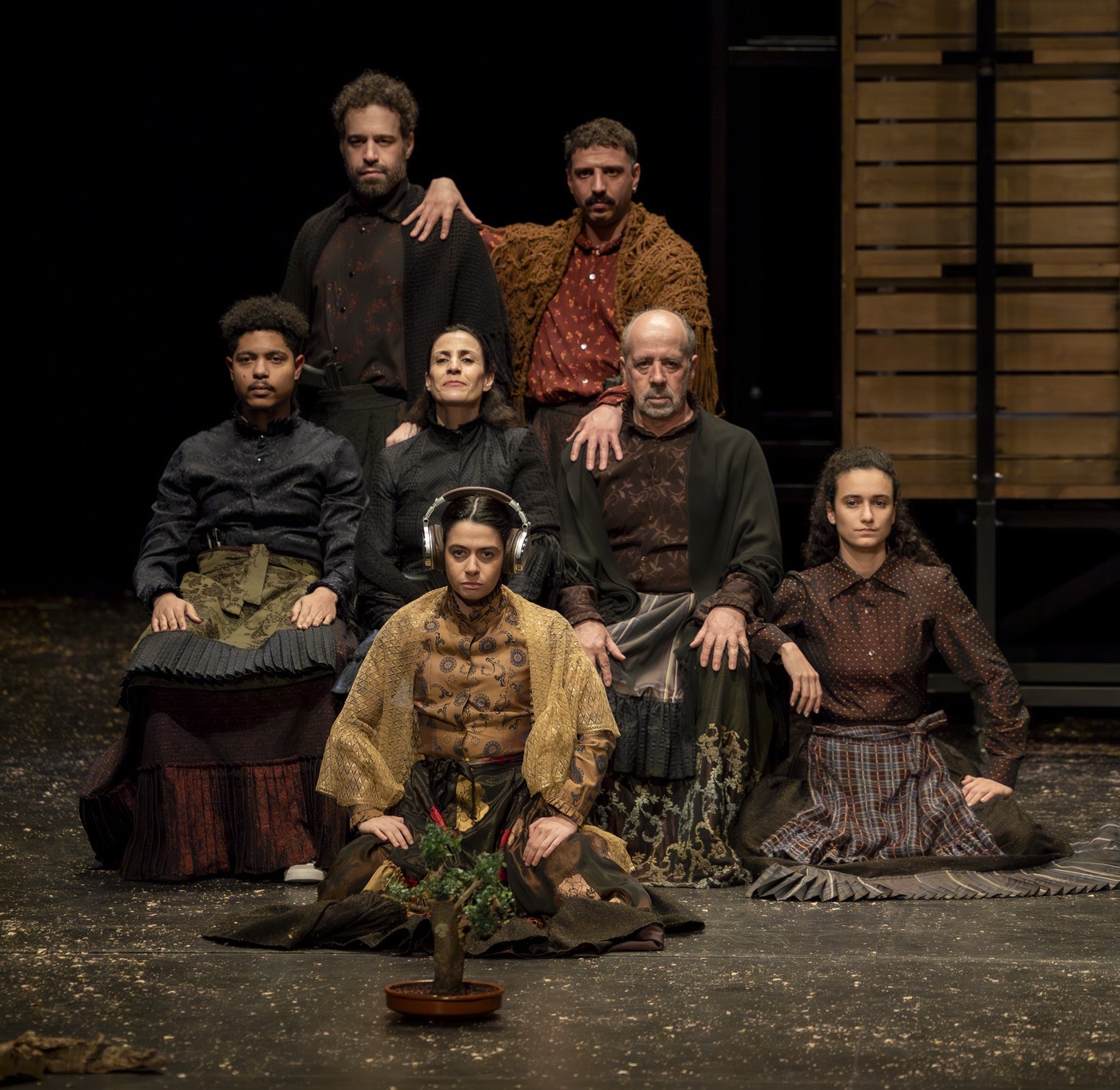
The set is the same one used across the touring of the world: the house, and a banquet table bearing the words “they won’t pass” in red, an ornate lettering that gives the dinner a festive flair as the family gathers to wait for a Catarina. Tiago Rodrigues, writing and directing, makes one choice that resonates above all others: the play stays in Portuguese, surtitled rather than performed in English.
It costs the show some of its reach, but is also a mark of pride in the language itself. Portuguese collapses “they” into a feminine plural when the group described is female, so the Catarinas refer to themselves as “she” in a way the surtitles can only flatten, no fault of Rodrigues‘, but a real loss for anyone reading rather than hearing it. He counterbalances that with a visual grammar instead: the cast dressed as older Portuguese women in dark colours, shawls over their shoulders, set against the fascist’s own uniform, a sharp blue suit and tie, the mark of a newer kind of fascist, one that supports the free market.
João Vicente is the performance to watch. His Catarina, who argues the killing is righteous and then quietly tries to sell the fascist’s release for money and another name, plays like every family’s failed-business uncle: full of ideas, wrong about most of them, quoting Brecht at the dinner table his hunger for the night’s pork trotters is played with the same appetite as his hunger to be right about something, just once.
Beatriz Maia, tasked with the killing itself, and Isabel Abreu as her mother, give the production its sharpest generational clash: two women who love each other and cannot agree on what are the family’s values. Beautiful clash of potent actresses. Romeu Costa, as the fascist, says nothing for the entire play until the end, when the ritual turns and he is left standing, seizing the moment to give a speech to us about a ‘new republic’.
A portrait of our times: elsewhere on tour, the speech has caused walkouts and boos; in London, the audience offered only careful, nervous laughter. We are, perhaps, too polite to disrupt great acting. But when the curtain fell, the ovation ran longer than almost anything I’ve witnessed at the National.
If there’s a stumble, it’s a small one: the mother spends a stretch of a pivotal scene upstaged in shadows, likely a holdover from years of touring the same set rather than a choice made for this room. It could have worked in the play’s favour instead, knowing when to retreat into shadow and when to let the light of righteousness find her again. Luckily it never dilutes the clash or the acting.
Does the play answer its own question, whether ridding evil at the root makes dictators of us all? No, and the ending refuses to let anyone off the hook for asking it. In a Portuguese-speaking house, where the language does its full lyric work, this is a five-star piece of theatre without doubts. Here, something is inevitably lost in the surtitles, so I’ll call it four. Like every Catarina on that stage, dissolving into the collective, the whole cast and creative team deserve real credit for it: this is a genuine masterpiece of theatre.
NEED TO KNOW: Catarina and the Beauty of Killing plays at the National Theatre until 26 Sep 2026 | Find out more.