

























Alexander Zeldin’s Care is not an easy watch. Set within the emotionally and physically draining world of residential care, it examines ageing, mortality and the painful decisions families make when they can no longer look after elderly relatives themselves. This is not comforting theatre, though flashes of humour occasionally puncture the gloom. Instead, Zeldin offers a hyper-realistic portrait of bodies and minds in decline. What it lacks, however, is a strong narrative drive, with the action often feeling less like a story than an extended observation of the slow, inevitable decline of old people.
At the centre of Care is Joan (Linda Bassett), a fiercely independent grandmother whose life is irrevocably altered after a fall leaves her increasingly vulnerable. Her daughter Lynn (Rosie Cavaliero), an exhausted widow already struggling to cope with two troubled teenage sons, Laurie (William Lawlor) and Robbie (Ethan Mahony), is confronted with a difficult decision. As Joan’s physical and mental health worsen, the family place her in a residential care home against her wishes.
“Care ultimately succeeds as a deeply compassionate piece of theatre that refuses easy sentimentality or neat conclusions”
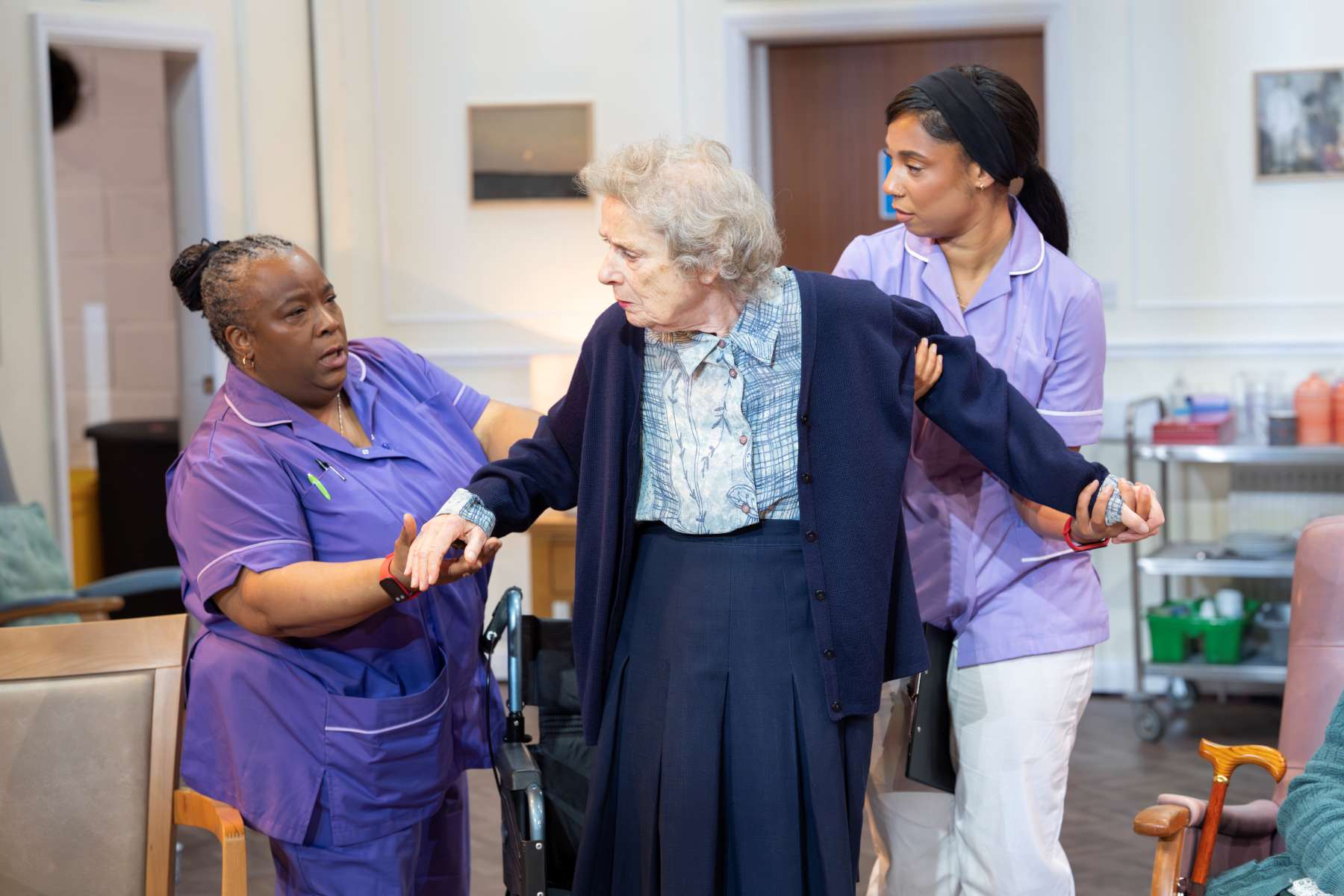
Joan arrives believing the move is only temporary, convinced she will soon recover from her injuries and return home. Instead, she finds herself trapped within a community of similarly fragile residents, each carrying their own loneliness, grief or confusion. Among them are the former sex worker Simone (Hayley Carmichael), the quietly heartbroken John (Richard Durden), still mourning the death of his wife, and the disoriented Agnes (Ann Mitchell). Overseeing them are the weary but compassionate senior carer Hazel (Llewella Gideon) and the inexperienced newcomer Fanta (Aoife Gaston) who show the emotional and physical demands placed upon care workers.
Linda Bassett gives a remarkable performance as Joan, capturing the painful frustration of an independent spirit trapped inside a body and mind that are steadily failing her. There is immense dignity in her portrayal, even in Joan’s moments of confusion and anger. Her chemistry with Rosie Cavaliero, who conveys the guilt, exhaustion and denial of a daughter watching her mother slowly disappear, forms the emotional heart of the production. William Lawlor delivers a moving performance as Laurie, the elder grandson, charting a believable transformation from detached teenager to someone willing to shoulder responsibility for his grandmother’s care. Yet while the performances are richly detailed, the writing leaves aspects of the family dynamic frustratingly underexplored. There are tantalising hints of long-standing tensions and unresolved histories but these are never developed enough to give the relationships their full emotional complexity.
The supporting cast bring the care home vividly to life, creating a world that feels wholly authentic in its mixture of sadness, humour and quiet routine. Hayley Carmichael is particularly memorable as the tempestuous Simone, whose frequent fixation on sex provides both comic relief and a reminder of desires that persist into old age. Richard Durden, meanwhile, delivers a deeply moving portrait of grief and elderly vulnerability. Yet several of the residents remain frustratingly underwritten, despite hinting at rich lives and compelling histories that the play never fully explores.
Llewella Gideon and Aoife Gaston are excellent as the care workers Hazel and Fanta, capturing both the compassion and fatigue of people attempting to provide dignity and emotional support within a system that constantly stretches them beyond their limits.
If Care has a weakness, it lies in the very realism that gives the production its emotional power. Zeldin’s commitment to depicting the rhythms of care home life means that scenes often unfold at an intentionally unhurried pace, lingering long after their emotional point has been made. This is clearly a deliberate artistic choice, reflecting the repetitive, exhausting and frequently uneventful nature of care itself. Yet while the approach deepens the play’s authenticity, it can also test the audience’s patience, with scenes feeling more observational than dramatically engaging.
Even so, Care ultimately succeeds as a deeply compassionate piece of theatre that refuses easy sentimentality or neat conclusions. Rather than offering comforting answers, it asks the audience to confront the discomfort, fear and uncertainty that surround ageing and the end of life. In doing so, Care is a carefully observed and quietly moving drama about dignity, responsibility and what it truly means both to care for others and to accept care ourselves.