





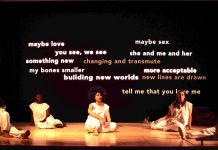

















Ahead of The Afronauts opening at the Royal Court Theatre this November, we sat down with co-directors Ryan Calais Cameron and Monique Touko to talk about the story behind the play, Black imagination, and why stories like this matter.
Zambia, 1964: the space race has a new contender. As the world’s great powers set their sights on the moon, a schoolteacher gathers a group of misfit dreamers and trains them for lift-off. The Afronauts tells the true(ish) story of the Zambian Space Program, and a nation’s defiant dream to reach for the stars.
Writer Ryan Calais Cameron’s The Afronauts is based on the “true-ish” story of Edward Makuka Nkoloso, a Zambian teacher and freedom fighter who, in 1964, created a space programme in a barn outside Lusaka.
For years, the story has mostly been treated like a joke online. Calais Cameron first came across it through a WatchMojo video about the “most ridiculous ideas” people had ever come up with, but said he immediately saw something else in it:
“This doesn’t sound ridiculous or stupid to me,” he said. “I fully understood what the ambition was.”
Years later, after seeing the story again as part of In the Black Fantastic at the Hayward Gallery, he knew it needed to become a play.
For Touko, the story felt personal in a different way. She admitted she’d never heard of Nkoloso before Ryan brought her the project, and as a Zimbabwean woman, that stayed with her.
“I felt ashamed that I didn’t know,” she said.
That idea of forgotten stories came up a lot during our conversation. Both directors spoke about Nkoloso’s project not as something ridiculous, but as something deeply political. To them, the space programme was really about liberation, identity, and the right to imagine bigger futures for Black people.
Calais Cameron spoke about how quickly ambition is mocked when it comes from Black hands, even though history celebrates the same kind of audacity elsewhere.
Monique saw the story as part of a wider conversation about reclaiming identity and imagining beyond colonialism.
“For the first time, we get to choose what our identity is,” she said. “And that in itself is political. It’s radical.”
We also spoke about Afro-surrealism and the challenge of bringing sci-fi into theatre, a genre that usually lives on screen. What Afronaut does is place Black bodies in space, on stage, in a way that feels imaginative but also grounding.
By the end of the conversation, it felt clear that Afronaut isn’t really about getting to the moon. It’s about what becomes possible when Black people allow themselves to dream beyond survival.
When I asked what they hoped audiences would leave with, Touko replied: “That we are beyond the confines society puts on us.”
NEED TO KNOW:
- The Afronauts plays at the Royal Court from 14 Nov to 19 Dec 2026 | See listing
- RYAN CALAIS CAMERON AND MONIQUE TOUKO ANNOUNCED AS CO-DIRECTORS OF THE AFRONAUTS
- ROYAL COURT THEATRE ANNOUNCES 70TH ANNIVERSARY SEASON