
















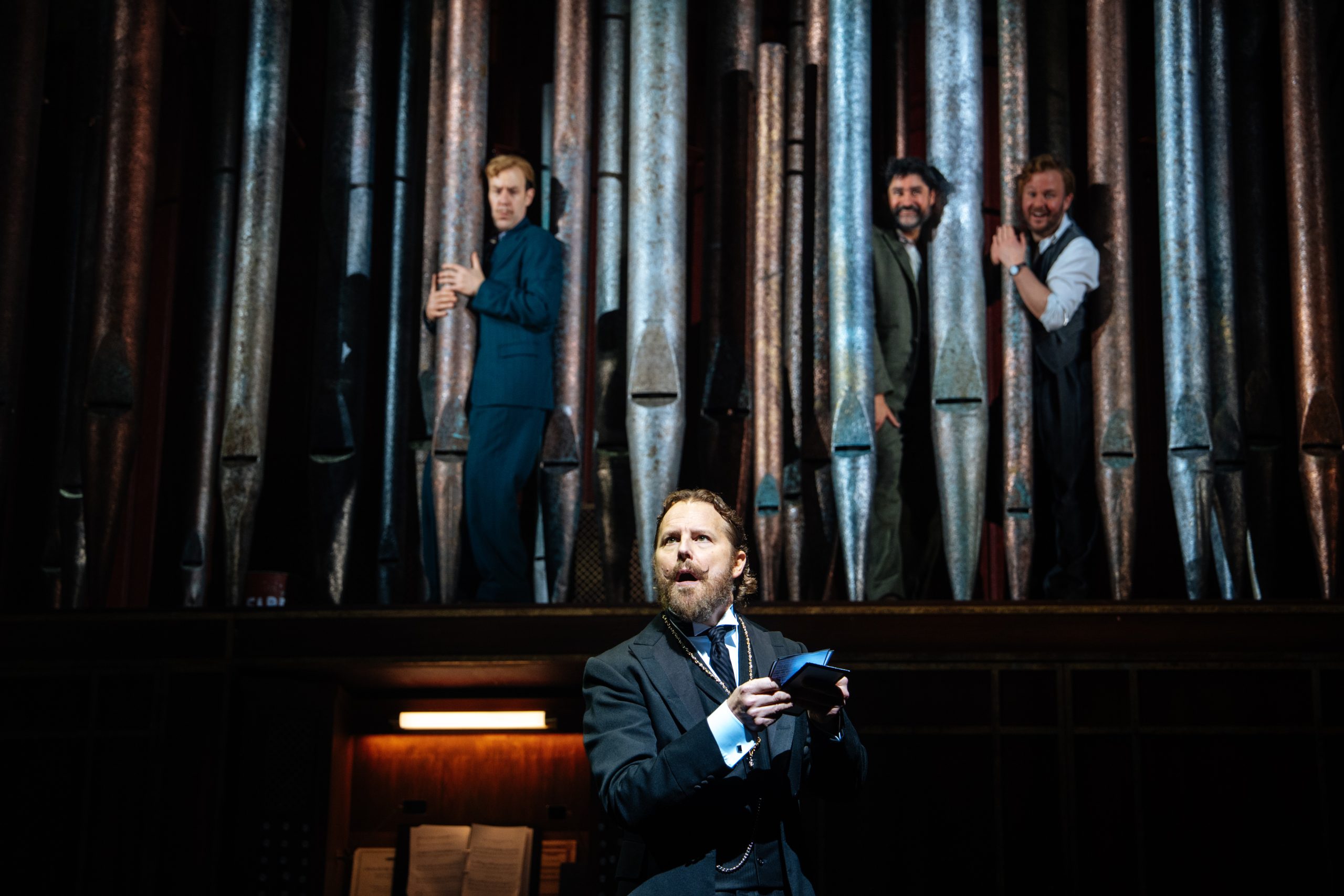
Prasanna Puwanarajah‘s adaptation of William Shakespeare’s Twelfth Night at the Barbican, transferring from a sold-out run in Stratford, is Feste’s production in name and in nature. The laughter started early and came often, and for much of the audience it apparently delivered exactly the Christmas tonic it set out to be.
Twelfth Night is among Shakespeare‘s more accessible comedies. Not as much as A Midsummer Night’s Dream, where Puck tells us outright he’ll contrive the most inconvenient circumstances to keep our lovers apart. His signposting is a kindness to modern audiences, trained to prize narrative and character development over playful indulgence. Here, we do not have that privilege; the plot is sacrificed at the altar of camp, chaotic licensed folly. But there’s appeal in a play that asks only that you show up ready to be charmed.
Shipwrecked twins, mistaken identities, love triangles that resolve with the benevolence of a fairy tale. Viola washes up in Illyria believing her brother Sebastian drowned, disguises herself as the boy Cesario, and finds herself caught in an impossible tangle: sent to woo the mourning Countess Olivia on behalf of the lovesick Duke Orsino, she falls for him while Olivia falls for her. Gwyneth Keyworth and Daniel Monks anchor this central confusion with a chemistry that gives it genuine weight; their scenes together are warm and grounded in a way that steadies the production when it starts to drift.

Freema Agyeman‘s Olivia took a while to settle. But once she found her rhythm and leaned fully into the ridiculousness of Olivia – the self-importance, the romantic melodrama, the sudden and ill-judged passion – she surpassed Feste, for me, as the most fun person on stage. Perhaps this is where the fault line will lie for audiences: between those who relish the Fool’s forced fun, and those, like me, who are more persuaded by the freedom an actor finds in committing to the emotional truth of a role.
I found much of the extended Fool sequences in the first half tough going. They felt long, at times wearing. I’ve always been far more drawn to Shakespeare’s tragedies than his comedies; I find them tighter, more riveting. Sitting through these stretches, I felt that gap acutely.
And yet – it was impossible to ignore what was happening around me. The laughter was constant and wholehearted; the mood in the auditorium unmistakably one of levity and joy. Even when I wasn’t personally cracking up, there was a contagious quality to that collective enjoyment. You want to be part of what’s happening; you want to enjoy it. That openness fed directly into the second half, which was tighter, quicker, and much more successful. Once the pacing settled and the play found something closer to rhythm, I laughed a great deal more freely than I had at the start.
Some of the emotional payoffs never quite hit the mark. The arc of Malvolio – usually one of the play’s richest sources of bittersweet complexity – doesn’t gather the bite or poignancy you might expect. Samuel West does what he can, but just as the character seems poised for something sharper, attention ricochets back to broader clowning. And the twin reunions, which are typically among Twelfth Night‘s most affecting moments, felt slightly rushed; present, but not given enough space to breathe.
Matt Maltese‘s original compositions contribute a dreamy, occasionally bittersweet atmosphere, and there are moments when the humour shades into something more contemplative. But the tonal balance is uneven. When the production leans into sentiment, it doesn’t always commit; when it leans into spectacle, it sometimes overwhelms the text.
I walked out feeling lighter than when I walked in – and on a bleak London day, that’s not nothing. But the production’s approach to gender and desire is what has stayed with me. Orsino courts Cesario with an openness that feels emotionally sincere, their intimacy played plainly and without strain. When they kiss, the queerness registers as a practical inconvenience to social arrangement, remarkable only for its romance. Olivia’s desire is situated similarly: when the twins are revealed, her attraction doesn’t resolve so much as expand, deepening with the possibility of loving a woman too.
Of Shakespeare’s plays, Twelfth Night is as camp as it comes, and here that potential is fully realised. The scale and spectacle that tested my patience also create room for a queer reality to sit comfortably without explanation, held entirely in earnest. In 2025, when the humanity of trans women is openly debated, the steadiness with which gender fluidity is treated here feels quietly radical – not because it argues for acceptance, but because it assumes it.