





















Not every beloved classic novel survives the leap from page to stage, as anyone who remembers the ill-fated 2008 New London Theatre production of Gone with the Wind can attest. Thankfully, Aaron Sorkin‘s adaptation of To Kill a Mockingbird, now revived at Wyndham’s Theatre, proves that a great reworking can do more than simply transfer a familiar story from one medium to another. Intelligent, emotionally gripping and superbly staged, it honours Harper Lee‘s celebrated novel while confidently establishing its own identity.
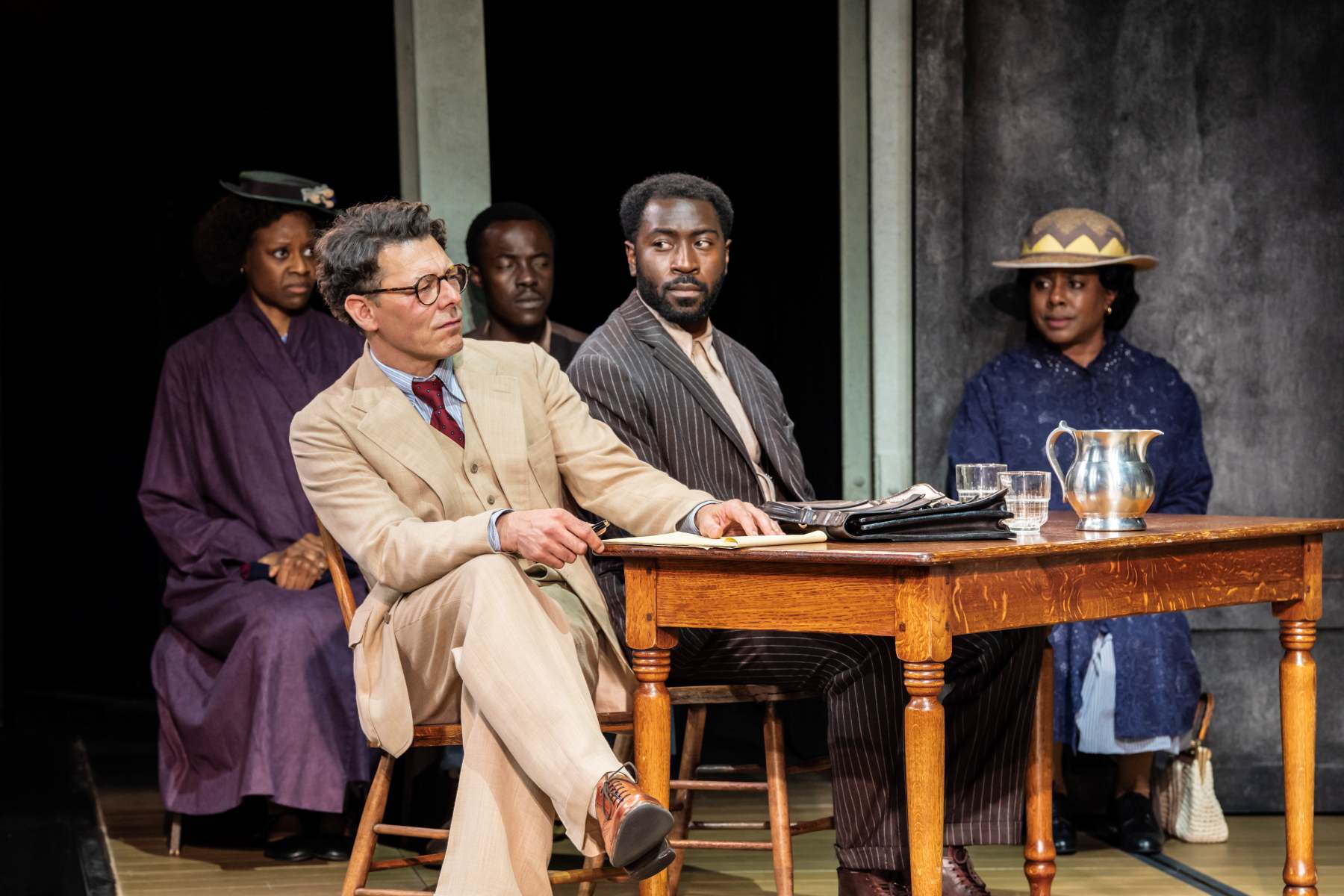
Set in a small Alabama town during the 1930s, the story is narrated by Scout Finch (Anna Munden), alongside her brother Jem (Gabriel Scott) and their awkward but endearing friend Dill (Dylan Malyn). The three children, convincingly portrayed by adult actors, serve as both participants in and commentators on the unfolding events. Stepping effortlessly in and out of the action, they address the audience directly as they recount how Atticus Finch (Richard Coyle) is appointed to defend Tom Robinson (Aaron Shosanya), a Black labourer falsely accused of raping a young white woman, Mayella Ewell (Evie Hargreaves).
One of Sorkin‘s most effective structural changes is to place the courtroom drama at the centre of the play from the outset, rather than introducing it midway as in Harper Lee’s novel. The narrative unfolds in a fluid, non-linear fashion, shifting between the trial and the events that lead up to it. As the evidence exposes the entrenched racism of the community, Scout, Jem and Dill begin to grasp the gulf between Atticus’s moral convictions and the prejudice that defines the world around them.
Richard Coyle delivers an outstanding performance as Atticus Finch, characterised by quiet authority and emotional restraint. Rather than presenting him as the untouchable moral hero familiar from the novel, Coyle reveals a man wrestling with doubt while striving to act with integrity. It is a nuanced portrayal that reflects Sorkin’s interest in examining, rather than simply venerating, one of literature’s most iconic figures.
Playing the children, Anna Munden, Gabriel Scott and Dylan Malyn capture both the exuberance of childhood and its gradual loss of innocence with impressive subtlety, never allowing their performances to drift into caricature. Their natural chemistry brings warmth and humour to the production, providing essential light relief in an increasingly darkening story.
Aaron Shosanya brings immense dignity and quiet heartbreak to Tom Robinson, ensuring he is seen as a fully realised human being rather than a symbolic victim of injustice. Evie Hargreaves, as Mayella Ewell, skilfully balances cruelty, fear and vulnerability, hinting at the social deprivation and abuse that shape her actions without excusing them. Oscar Pearce is chilling as Bob Ewell, embodying the ugly mix of ignorance, resentment and performative bravado that fuels his poisonous racism. Even relatively minor characters are given sufficient depth to avoid becoming simplistic symbols of good or evil.
Bartlett Sher’s assured direction avoids sentimentality, allowing the emotional force of the story to emerge naturally without manipulation and unnecessary embellishment. Miriam Buether’s clever set places much of the action on Atticus’s porch and in the courtroom, while fluidly transforming into other locations as required. The scenery shifts with remarkable speed and precision, often between almost every scene, yet the transitions are so nimbly executed that they never distract
Sorkin’s adaptation wisely resists treating Harper Lee’s To Kill a Mockingbird as untouchable, instead sharpening its focus and engaging more directly with some of the novel’s more problematic elements. Atticus emerges less as a “white saviour” figure and more as a man whose moral certainty is tested, revealing blind spots as well as convictions. The Black characters are given greater agency, their perspectives more fully present within the drama rather than filtered solely through white experience.
Sorkin’s intelligent adaptation, Sher’s assured direction and a uniformly excellent cast combine to create a production that honours Harper Lee’s novel while confidently establishing its own theatrical voice. While remaining true to the story’s enduring themes of justice, empathy and moral courage, it also probes questions of prejudice, privilege and individual responsibility that feel as urgent today as ever. In an age when those issues remain pressing, this compelling revival confirms that To Kill a Mockingbird still has the power to move and challenge its audience and deserves to be seen.
NEED TO KNOW: To Kill a Mockingbird plays at the Wyndham’s Theatre until 12 Sep 2026