






















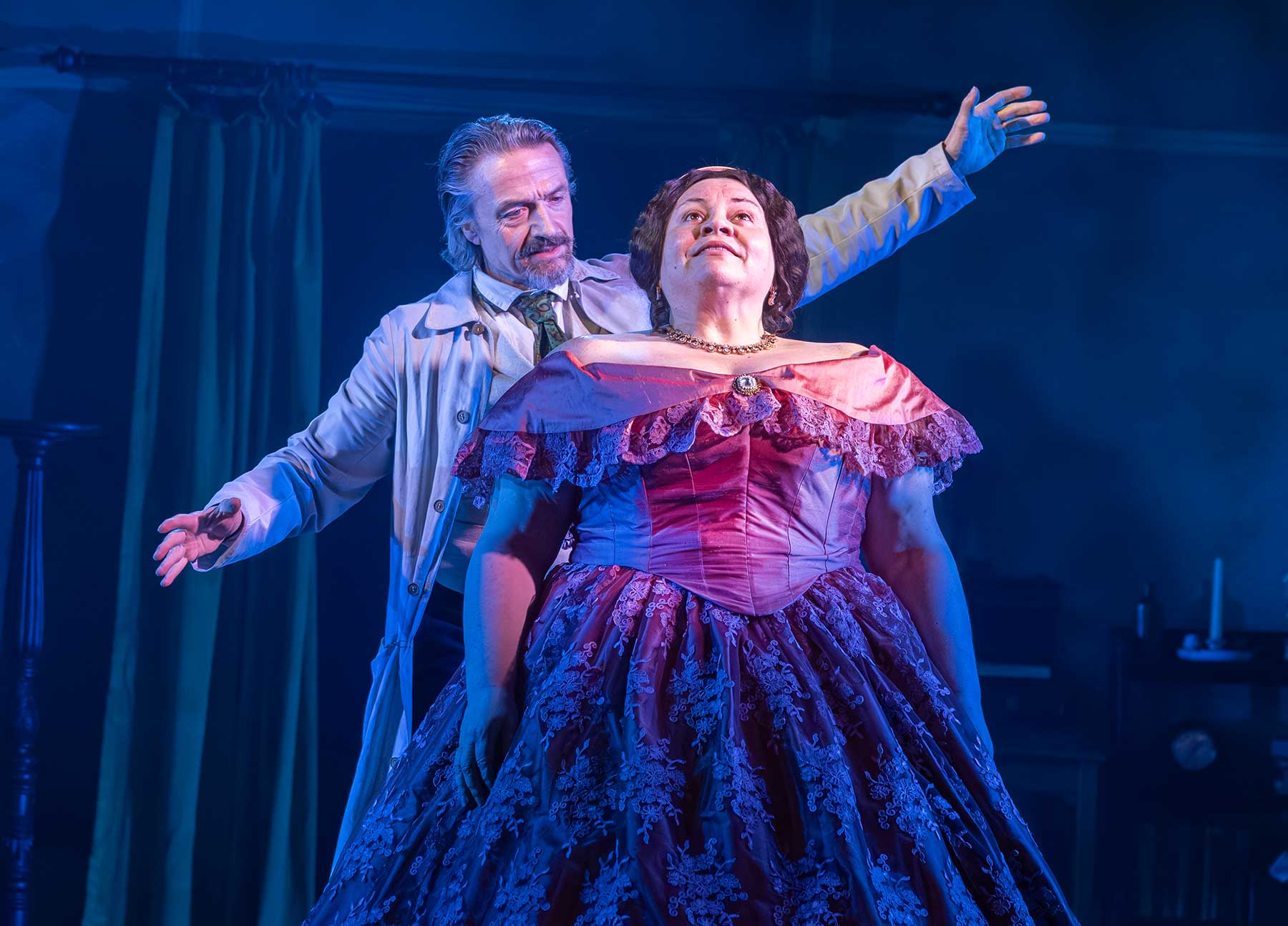
For a figure from American history that many people, myself included, know relatively little about, Mary Todd Lincoln is enjoying something of a renaissance on the London stage. Two productions are currently being staged in which she is the central character. Last month, Oh, Mary! opened at the Trafalgar Theatre, offering a raucous and irreverent take on her life. Now, a far more serious interpretation arrives at the Charing Cross Theatre with Mrs. President, a fascinating and emotionally rich two-hander that continues the process of reclaiming Mary Todd Lincoln from the margins of history.
Set entirely within the photographic studio of Mathew Brady (Hal Fowler), the play imagines a series of encounters between the First Lady and the celebrated photographer, as she commissions him to take a series of portraits of her in the years leading up to and following Abraham Lincoln’s assassination. Mary explains that she wants the portraits “to change people’s perceptions of me”, although the play never makes it entirely clear how she is currently viewed by the public and it feels like a missed opportunity that this idea is not explored more deeply.
As she prepares to be photographed, Mary Todd Lincoln, or “Mrs. President” as she insists on being addressed, engages Brady in conversations that reflect on her marriage, her time in the White House, the trauma of repeated loss and the way history has judged and often misunderstood her. What emerges is an engaging exploration of grief, legacy, public image and self-identity.
Mary’s life has been marked by extraordinary tragedy. In addition to witnessing her husband’s assassination, she lost her mother at a young age and all but one of her sons died in childhood. In the play, however, her grief focuses almost exclusively on the death of her son Eddie, with the others receiving only passing mention. Even her husband’s murder fails to redirect that focus. This imbalance is never fully explained and slightly narrows what could have been a broader and more nuanced examination of her experiences of loss.
Keala Settle delivers a commanding, richly layered performance as Mary Todd Lincoln, giving the production much of its emotional force and lifting it onto a higher level. Her portrayal moves confidently across a wide emotional range while remaining grounded and controlled. At times, Mary is forceful and demanding, acutely aware of her position and determined to assert it; elsewhere, she appears unsettled and isolated, worn down by grief and suspicion. These shifts are handled with care, so they feel natural rather than exaggerated. Crucially, Settle avoids turning Mary into a caricature, instead presenting her as a complicated and often contradictory figure: difficult, passionate and deeply human.
Hal Fowler is effective as Mathew Brady, bringing a calm, measured presence that provides a counterbalance to Settle’s intensity. His Brady appears more concerned with his reputation and the artistic integrity of his photographs than with fulfilling Mary’s expectations, creating a subtle but compelling tension between the two characters.
Playwright John Ransom Phillips’s script raises interesting questions around identity, public perception, gender and grief, but it doesn’t always explore them as fully as it promises. Scenes unfold in fragments that are often rich in symbolic potential, yet at times feel a little too abstract to fully grasp. There were moments when it was difficult to tell what I was watching: a dream sequence, a psychotic episode, or a memory replaying itself. This ambiguity can be intriguing, but it occasionally becomes frustrating.
Director Bronagh Lagan’s staging is visually striking and imaginative, making particularly effective use of video projections. Anna Kelsey’s set design presents Brady’s studio with convincing period detail, while lighting and sound work together to create atmospheres that shift from unsettling to intimate. However, despite the production’s visual sophistication, there are moments when the storytelling feels less clear than it might be and the emphasis on mood occasionally comes at the expense of narrative focus.
Mrs. President is an ambitious and often absorbing piece of theatre. At its best, it offers a thoughtful and emotionally resonant attempt to reframe Mary Todd Lincoln as a complex woman shaped by grief, power and scrutiny, rather than a marginal historical figure defined by tragedy alone. Keala Settle’s commanding performance gives the play its emotional core, supported by Hal Fowler’s measured and intelligent turn as Mathew Brady. However, moments of narrative ambiguity and underdeveloped ideas left me frustrated and wanting greater clarity. Even so, the play’s strengths outweigh its shortcomings. Mrs. President is a compelling and often moving experience, offering a striking portrait of a woman fighting to control her own story.
NEED TO KNOW: President runs until 8 Mar 2026 at the Charing Cross Theatre