



















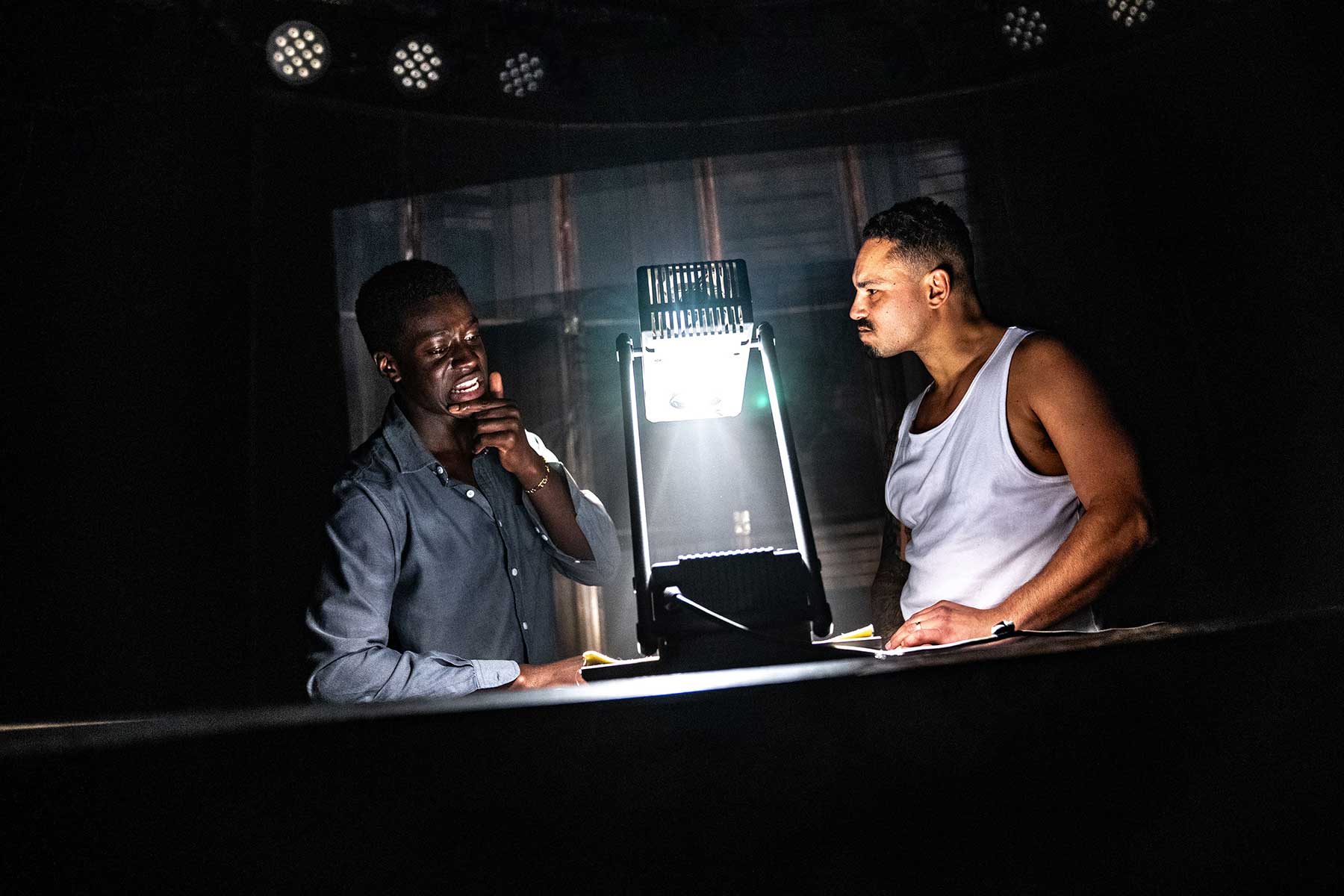
Miles Davis grew up in a world that shaped every note he played, but this production never really commits to telling that story. I’ve always believed you cannot separate the art from the artist; their lived experience runs through everything they create, and with a figure so politically charged as Davis, that feels especially vital. This presents a more palatable version of Miles, one where uncomfortable truths are softened or reduced to passing reference.
The show, written and directed by Oliver Kaderbhai touches on his childhood in segregation, police brutality, racism, and his drug use, but only in glimpses. It seems eager to cram in key moments without allowing any of them the time or weight they deserve, and I left not much the wiser about the man behind the music. What emerges is a collage of familiar biographical beats, lacking the depth you’d hope for in a play about such a well‑documented life.
The concept itself has potential: a ghostly, spiritual encounter between a struggling contemporary musician and DJ (Jay Phelps), and Davis (Benjamin Akintuyosi). In theory, this set‑up could have opened up a genuinely probing conversation about legacy, influence, addiction, ego and race, bridging past and present.
Threads of story weave in and out like a fever dream, but with no defined acts and only the interactions between the two loosely binding the scenes together, the writing lets the premise down. Scenes arrive and dissolve, rarely building into anything cumulative.
MILES manages to scratch the surface of many aspects of Davis’s life yet refuses to delve deeper, leaving a frustrating sense of absence at its core. The impressionistic approach might have felt purposeful had the show committed to a stronger emotional or political through‑line; instead, it hovers, gesturing at ideas it never fully interrogates. Visually, the production is often over‑lit, with isolated moments of effective drama created through changes in lighting.
At points the stage is so bright I can clearly see the audience’s faces around me, which becomes unintentionally revealing. There are a few instances where the lighting achieves what you might expect of a show about a musician associated with jazz clubs, cigarette smoke and danger.
The striking opening tableau, as everyone takes their seats and Akintuyosi’s Miles lies passed out on the piano, promises a bold interrogation of Davis’s inner life and the world that shaped him. For a moment, the stillness, composition and tension in that image suggest a production ready to sit with difficult truths. Projections of recordings and photographs of Miles and the people in his life are used well, giving the audience a peek into the world Miles lived through.
The saving grace is Benjamin Akintuyosi and Jay Phelps’s performances, which repeatedly pull my attention back over the 90 minutes. The music, played live by Phelps, is genuinely captivating and brings much‑needed energy and focus whenever the script falters. Akintuyosi’s dynamism is electric in the small theatre, shifting between swagger, vulnerability and anger with a commitment that suggests a deeper play fighting to break through.
Both actors also slip into multiple figures from Miles’s life – collaborators, friends, industry gatekeepers – underlining how many forces shaped him. Kudos to both; they provide flashes of what this show could have been, even if the play itself never quite finds its soul. In the end, the missing piece is the historical and racial context that forged an artist of such magnitude. Without a willingness to really confront that, MILES feels more like an echo of Davis than a true exploration of the man or his music