






















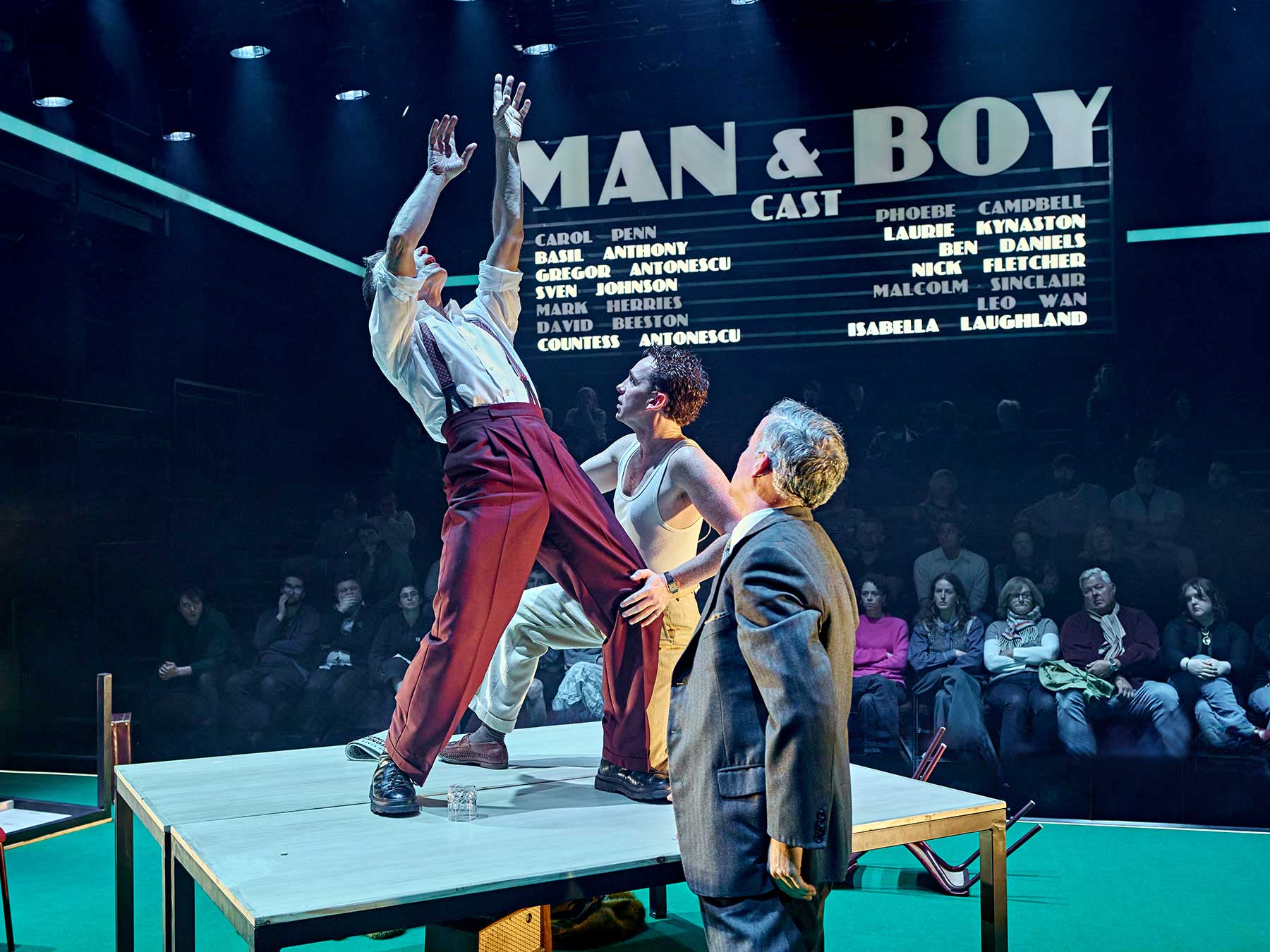
Man and Boy is regarded by many as one of the lesser plays in playwright Terence Rattigan’s otherwise strong body of work, which may go some way to explaining why the current revival at the National Theatre’s Dorfman marks its first major outing in two decades. Set in the 1930s but first staged in 1963, the play risks feeling like a period piece twice over, and director Anthony Lau has clearly tried to prise it out of the past by giving the production a more contemporary feel. The result is slick and often impressive on a technical level, yet despite these efforts, I couldn’t help feeling that the play’s reputation is not entirely undeserved.
The play centres on Gregor Antonescu (Ben Daniels), a Romanian financier whose business empire appears to have been built more on charm, bravado and sheer force of personality than on anything resembling sound financial practice. When his web of fraudulent deals begins to unravel, Gregor flees to the Greenwich Village basement flat of his estranged son (Laurie Kynaston), who has changed his name from Vassily Antonescu to Basil Anthony in an attempt to escape the toxic legacy of his father. Gregor abandoned Basil years earlier and the two have not seen each other for five years. This is not, however, going to be a warm family reunion. Basil is still angry at his father’s neglect and exploitation, while Gregor has tracked down his son for a specific reason: not to become a loving father, but to use Basil’s apartment, and Basil himself, as part of a plan to save his business.
In a desperate bid to rescue his collapsing empire, Gregor invites the closeted chairman of American Electric, Mark Herries (Malcolm Sinclair), to discuss a potential merger. To facilitate the agreement, he allows Mark to believe that Basil is his lover and, more disturbingly, hints that Basil could be made sexually available to him. Basil, entirely unaware of his father’s manoeuvrings, becomes an unwitting pawn in a scheme that lays bare the depths of Gregor’s moral bankruptcy.
At the heart of the production is Ben Daniels’s commanding performance as Gregor. He brings a fascinating blend of charisma and menace to the role, creating a figure who can be charming, calculating and quietly ruthless within the same moment. Daniels captures the slippery amorality of a man for whom personal relationships are simply another means of advancing his own interests.
Opposite him, Laurie Kynaston gives a quietly devastating portrayal of Basil. His performance begins with an endearing vulnerability of a young man still bruised by abandonment and develops into someone stronger and more self-assured, marked by an emotional openness that contrasts sharply with his father’s tough pragmatism.
The supporting cast add further texture to the production. Phoebe Campbell brings warmth and alert intelligence to her role as Basil’s girlfriend, Carol Penn. Isabella Laughland portrays Gregor’s wife, Countess Antonescu, with a mix of flamboyance and fragility that hints at the deep emotional neglect within her marriage. Malcolm Sinclair gives Mark Herries an intriguing combination of authority and vulnerability, tinged with an unsettling creepiness, while Leo Wan’s quietly watchful accountant, David Beeston, provides a subtle reminder of the moral compromises required to keep Gregor’s empire afloat.
Director Anthony Lau approaches the material with a clear eye for contemporary relevance without sacrificing the integrity of the period setting. The pacing is brisk and the physicality of the staging more pronounced than I had expected, with characters constantly in motion, climbing on and off tables and shifting furniture at speed. This restless choreography is tightly controlled and impressively precise.
Staged in the round, the production makes inventive use of Georgina Lowe’s simple but effective set. On one side of the space, a large sign lists the characters alongside the actors playing them, with names illuminated as they appear on stage. It is a striking visual device, but one that feels faintly gimmicky, drawing attention to itself without adding much in the way of atmosphere or storytelling.
This revival of Man and Boy at the National Theatre’s Dorfman offers an intriguing theatrical experience that is emotionally fraught, expertly performed and cleverly staged. It breathes new life into a play that is generally less highly regarded than Rattigan’s more celebrated works and, in a post-Jeffrey Epstein world, its murky entanglement of power, sex and corruption feels uncomfortably current. What may once have seemed like a melodramatic moral fable now plays as a bleakly familiar portrait of how easily privilege can shield predatory behaviour, lending this revival a relevance that extends beyond the confines of the period drama.