




















What happens when a classroom text stops feeling like fiction? In Kimberley Belflower’s John Proctor Is The Villain, set during the #MeToo era and now playing at the Royal Court Theatre, studying the play The Crucible becomes uncomfortably real for a group of high school students in Georgia. As they dissect Arthur Miller’s classic drama of the Salem witch trials, the text soon becomes more than just a piece of literature on their English syllabus, it becomes a lens through which they begin to question power, gender, reputation and how society can protect powerful men while silencing women.
The students study and debate The Crucible under the guidance of their well-liked, seemingly “cool” teacher, Carter Smith, played by Dónal Finn with a compelling blend of charisma and something more unsettling beneath the surface. When the girls attempt to set up a feminist club, only to be warned by school counsellor Bailey Gallagher (Molly McFadden) that it could prove problematic for the school, it is Mr Smith who steps in, offering to act as the club’s sponsor so it can go ahead.
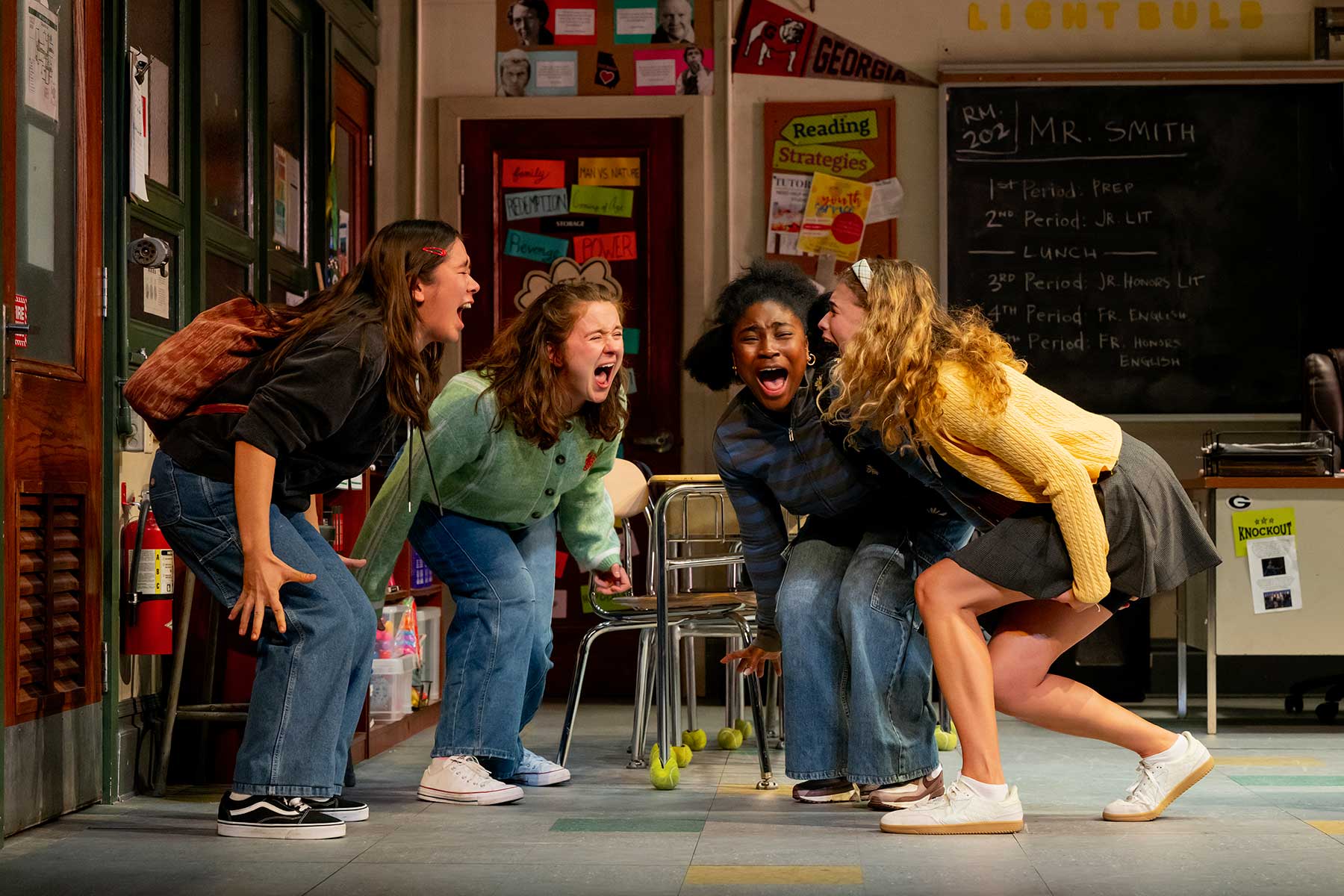
For a school supposedly constrained by budget cuts, the class is improbably small, just seven students, five of whom are girls, and it is their voices that dominate the play. There is Beth (Holly Howden Gilchrist), a high-achieving book lover with an almost reverential admiration for Mr Smith, Ivy (Clare Hughes), her wealthy and loyal friend, Raelynn (Miya James), a preacher’s daughter, Nell (Lauryn Ajufo), a perceptive outsider newly arrived from Atlanta and Shelby (Sadie Soverall), the returning “problem child.” The two boys, Lee (Charlie Borg) and Mason (Reece Braddock), have smaller but nonetheless pivotal roles.
Mr Smith remains adamant that John Proctor is the ultimate hero of The Crucible, a man of integrity who sacrifices his life to preserve his name. The girls, led most forcefully by Shelby, challenge this perception, arguing that a man who has committed adultery with a much younger girl can hardly be held up as heroic. In their eyes, John Proctor is not the moral centre of the play, but its villain.
As the play unfolds, the parallels between The Crucible and the girls’ own lives become increasingly explicit and unsettling. Raelynn, already coming to terms with her break-up with Lee following his brief involvement with Shelby, finds herself further wrong-footed when he forcibly kisses her with a casual sense of entitlement. Meanwhile, Ivy is confronted with a crushing betrayal as news emerges of her father’s involvement in a sex scandal with one of his employees. However, the most shocking revelation of sexual abuse, one that is even closer to the girls, is yet to come. Taken together, these events expose the same patterns of male privilege, revealing how a man’s otherwise respectable standing can be used to excuse or minimise abusive behaviour.
The ensemble cast is uniformly impressive, delivering performances that feel raw and often painfully real. No single actor dominates the stage, an approach that feels appropriate for a play rooted in collective awakening rather than individual heroism. Each performer brings a distinct emotional truth to their role, charting subtle shifts in loyalty, confidence and self-awareness with impressive control. The group dynamic feels authentic throughout, allowing moments of confrontation and vulnerability to land with particular force.
Despite the serious subject matter of John Proctor Is The Villain, Kimberly Belflower’s writing is full of humour and teenage pop-culture references. This provides a welcome lightness that contrasts effectively with some of the play’s more uncomfortable moments. Danya Taymor’s direction is brisk and assured, maintaining momentum throughout. The play runs without an interval and I was surprised by how quickly its one hour and 45 minute runtime passed.
What I liked about this production is how it invites the audience not simply to accept that John Proctor is the villain but to question why he has so often been regarded as the hero. The parallels between The Crucible and the girls’ own experiences are skilfully made, resulting in a sharp, funny and compelling exploration of the abuse of women by men. It is unsettling and thought-provoking without ever feeling preachy, and is ultimately quite moving.