




















I remembered last night one of the first poems I read at school, Valentine, by Carol–Ann Duffy. You know, the one that starts “Not a red rose or a satin heart. I give you an onion. It is a moon wrapped in brown paper. It promises light, like the careful undressing of love.” It ends, “Its scent will cling to your fingers, cling to your knife.”
I was thinking about the moon, love and layers watching the late Chadwick Boseman’s Deep Azure, in the perfectly intimate and beautiful interior of the Sam Wanamaker theatre. Boseman wrote his play in 2005 and was inspired by his friend and fellow Howard University student, Prince Jones, who was killed in 2000 by a police officer. Directed by Tristan Fynn-Aiduenu (For Black Boys Who Have Considered Suicide When the Hue Gets Too Heavy) and atmospherically lit. Do not underestimate the power of candlelight.
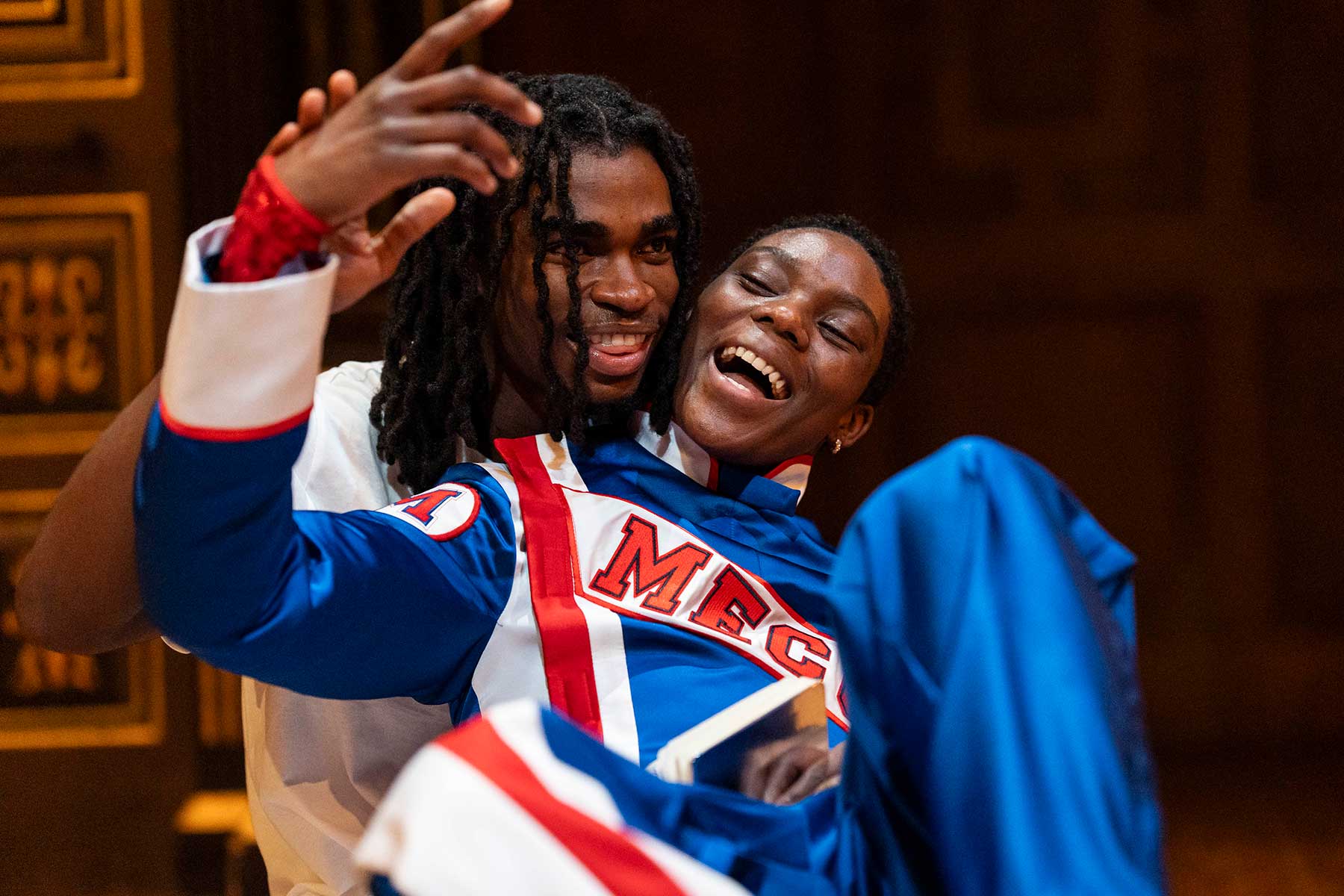
This is a play that feels both of its time, from the music, and an extended montage through late 90s early 00’s television and dances we recognise from the Heavenly MCs of Street Knowledge and cast throughout, but also sadly contemporary. The hooks of the story are familiar. Selina Jones’ Azure’s is captivating as a woman wracked with guilt, anguish and a damaging self-body image, struggling with the loss of her fiancé, Deep, played by Jayden Elijah. The young black man is killed in seemingly clear and yet strangely unclear circumstances.
You have a police officer, off duty, who has slain him and he too is a black man. You have a friend Roshad played by Justice Ritchie, with a fierce barely contained desire for revenge early on chanting “No justice, no peace, no crooked police” confronting us, grounding us, surrounding us, literally. And another friend, Tone, played by Elijah Cook, trying to get the centre to hold. To keep them all, sane and level as the machinations of seeking justice through the courts, looms like weighted blanket over them all.
I felt a sickening feeling in my gut, that the result would be what it is always is. The violence justified as proportionate to the threat. The questions of how black and brown officers reckon with this work (Tone, is a police officer too) when so often in the United States it black and brown people is being murdered or incarcerated, left unanswered. ICE came to mind, more than once. As I said, sadly contemporary.
Imani Yahshua as Street Knowledge of Evil and the officer who is accused of murdering Deep, stood out in a crucial section of the story moving deftly from aimable, nervous but inoffensive to sinister and frightening with striking contortions of his face and body that made me think of The Tethered in Jordan Peele’s US. I found myself shifting behind the pillar to avoid looking at him. He got under my skin.
Props to Tanaka Bingwa, Movement Director, who throughout used movement, and dance, a touch, a push, here and there to convey many different sentiments throughout. Be it the “careful undressing of love” in an early date scene being retold to a grieving mother, to Azure’s internal dialogue on her weight and shape manifested and reconciled through how she appears to men, in a beautiful scene, (I don’t want to spoil it for you) with a Balletic transformation.
I could see the plot twists coming, but that did not matter because it was the unfolding, complex and at times a little too long, that made it so richly layered. We can talk about word play. There is a lot of it. It is after all, a hip-hop opera influenced by the poetry of Shakespeare. The weaving of past into present through memory.
Deeps’ talking to us from beyond the grave through his diary, accompanying us and his friends on their exterior and interior conversations with one another and themselves. But it is not an academic exercise, it is at once conjuring something very grounded in a brutal reality and a reckoning with spirituality, with God. It’s rap. It’s poetry. It’s hip hop and it felt like the only way those words could have been said and those sentiments expressed.
By midway through the second half, I was fatigued, but this was not from boredom. I knew where we were headed and frankly, I did not want to get there. I wanted to see more stories. Different stories. I wanted to see Azure’s journey to healing and what her love of self would look like. I wanted to see what redemption looks like when justice is served. I wanted to see Deep’s life had he lived and thrived. And his mother who laments that of all the things we anticipate as mother’s she could not see his death coming.
So, this play feels important, for its own sake and its inspiration, the lived experience of Boseman, the death of Prince, but not as catharsis, not for us. Instead, a catalyst for more.
Related links
Cast announced for Deep Azure at Shakespeare’s Globe
Need to know: Deep Azure is playing at the Sam Wanamaker Playhouse, Shakespeare’s Globe until 11 Apr 2026 | see listing